
By: Nate Talkad
You know that feeling when you’ve been studying for hours and hours the night before your exam, and you’re feeling prepared, and then you show up and think to yourself, “I have never seen any of this in my life”? It can be quite frustrating, confusing, and frankly a little demoralizing. But here’s the thing: your brain isn’t full of cobwebs, it’s just a little confused due to something called cognitive interference. A sneaky, everyday memory blunder that affects not just college students, but every single human without them even realizing it.
Cognitive interference happens when different memories compete with each other. Think of it like trying to listen to two people talking to you at the same time. You may catch some words from one person and some from another, and by the end of it, you’re left confused and not knowing what either of them were talking about. The same thing happens in your mind when old and new information overlap.
Understanding this phenomenon can completely change the way you study and scrape through your classes. let’s dig into what interference is, how it shows up in real life, and what the research says you can do to fix it.
What Exactly is Cognitive interference?
Cognitive interference is a memory problem that occurs when information gets mixed up, overwritten or blocked by other information. Psychologists break it into two pain types: proactive interference and retroactive interference.
Proactive interference happens when old memories interfere with new learning ones. Imagine you spent years learning Spanish in highs school. Now you’re in college and thought you would be cool and took Italian instead. But now, whenever you practice your Italian, you say “gracias” instead of “grazie”. It’s not that you suddenly don’t understand Italian, it’s that your older, stronger Spanish memories are intruding on the newer Italian memories.
Proactive interference doesn’t just happen with languages, it shows up in many different ways such as learning a new mathematic formula similar to a previous one, getting a new class schedule but still going to last semesters classes, switching from APA to MLA formatting. Your brain loves habits and patterns. When new information resembles old information, the old stuff often wins the competition.
Retroactive interference is (shockingly) the opposite: new information makes it harder to remember old information. So, the exam is tomorrow morning, and you haven’t studied at all. you start from the beginning of lecture in chapter 1 and study up to chapter 3. By the time the exam comes around, you for some reason can only remember material from chapter 3 and barely anything from chapters 1 and 2. That is retroactive interference. You were so focused in retaining new information that you, somewhat paradoxically, forgot everything you previously went over. The new material has overwritten the old material.
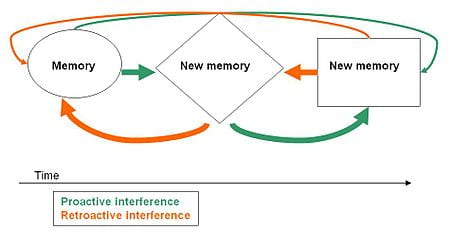
This happens most often when you cram multiple subjects into one session, when you learn new vocabulary right after old vocabulary, or studying similar subjects back-to-back. Your brain is constantly updating itself, and sometimes those updates accidentally delete things you still need.
How Interference Actually Affects You
Interference isn’t an abstract theory you hear about in class and never truly experience in the real world, it’s woven into your daily life, yet you may have never even known it.
If you go from studying child development to psych of learning to cognitive psych all in one sitting, odds are you are the information you are taking in is going to overlap and get mixed up with information from other classes. These subject all share similar underlying concepts, terminology, and themes, so your brain stores them in similar ways. This causes them to compete during retrieval.
The age-old method of cramming all information into one night of studying is a breeding ground for interference. The material is processed so close together that the memories blur and overlap. You may feel like you perfectly understand everything in the moment, but the next day everything collapses into a vague mess of half-remembered ideas.
Ever start a new semester and keep walking to last semester’s classes? That’s proactive interference in action. Your old routine is so engrained in your mind that it overrides the new schedule you are still getting used to.
Terms like “proactive” and “retroactive” interference (ironically) interfere with each other. When definitions share structure or wording, your brain struggles to keep them as separate terms.
Underneath all of this are much deeper cognitive mechanisms such as working memory limits, encoding specificity, and overlapping neural networks that are all working against you when you try that last minute study session. But this is a lot of information that can be quite confusing and overwhelming to take in. That’s where the research comes in.
What the Experts Say About Interference
Cognitive psychologists have been studying interference for decades, and their findings give us powerful insights into how to study more effectively.
Underwood (1957) found that the more similar items are, the more likely they are to interfere with each other. This is why studying two similar subjects back-to-back can be risky. Your brain stores the information in overlapping ways.
Keppel (1964) showed that spacing out study sessions reduces proactive interference. When you give your brain a break between learning sessions, it consolidated the first set of information before the next set arrives.
Taylor and Rohrer (2010) found that mixing different types of problems improves learning because it forces the brain to notice differences between concepts. This process is known as interleaving. This reduces proactive interference by making each concept more distinct.
These finding aren’t just theoretical; they directly translate into better study habits that have direct improvement on your life.
How You Can Reduce Interference
Here is a list of methods on how to apply everything you’ve learned in a way that makes studying work WITH your brain instead of against it.
Avoid studying subject back-to-back. As stated before, studying multiple subjects quickly ends up blurring the information. If you have similar subjects to study, it is best to space them out from each other, so you have time to process each subject. Do Cog Psych -Algebra – Psych of Learning instead of Cog Psych – Psych of Learning – Algebra.
Take a rest break in between subjects. This can vary quite a bit, depending on what you’re feeling. It can be a quite 5-10 minute break, where you go for a walk, stretch, maybe grab a bite to eat, or it can be a full day break. This gives your brain time to soak in the information you were studying without being interfered by competing information.
Before you get back to studying, review the old material before jumping into the new material. This helps refresh some of that information, so it doesn’t get buried by the incoming material.
SLEEP. I’m sure you’ve heard this before, but sleep is the most important thing you can do to ensure the information stays in your brain. Sleep is like hitting “save” on your brain. sometimes, even a short nap can protect the material from interference.
Your Brain Isn’t Overloaded, It’s Just Confused
Cognitive interference is one if the biggest hidden barriers students face on a daily basis when studying. But once you understand how it works, you can design your study habits in a way that avoids it. Try some of these methods we’ve gone over, and you will see a massive improvement with your memory recollection. Your brain isn’t the problem; your study strategy is. Now you have the tools to fix it.
References
Ellenbogen, J. M., Hulbert, J. C., Stickgold, R., Dinges, D. F., & Thompson‑Schill, K. S. (2006). Interfering with theories of sleep and memory: Sleep, declarative memory, and associative interference. Proceedings of the National Academy of Sciences, 103(5), 1575–1580.
Keppel, G. (1964). Facilitation and proactive inhibition in short‑ and long‑term retention of paired associates. Journal of Verbal Learning and Verbal Behavior, 3(2), 91–100.
Roediger, H. L., & Karpicke, J. D. (2006). Test‑enhanced learning: Taking memory tests improves long‑term retention. Psychological Science, 17(3), 249–255.
Taylor, K., & Rohrer, D. (2010). The effects of interleaved practice. Applied Cognitive Psychology, 24(6), 837–848.
Underwood, B. J. (1957). Interference and forgetting. Psychological Review, 64(1), 49–60