Let’s Mix it Up: A Study Method That Actually Works!

How Interleaving seems harder, but works better.

By: Brailyn Zimmerman

Let me guess… you go to study for a test by rereading the same material, focusing on one subject for hours until it “feels” mastered, or doing the same problems over until you physically can’t, just to get to the exam and realize that all the cramming didn’t work as well as you thought. 

It’s okay, you aren’t alone! Most of us study this way because it’s organized and productive, right? Cognitive psychology research suggests this may be one of the least effective ways to learn. 

That disconnect is exactly why interleaving is such a game-changer. Mixing up different types of problems or topics during the study session instead of focusing on one at a time may feel harder in the moment, but research in cognitive psychology shows it actually leads to better learning and retention in the long run.1

Continue reading “Let’s Mix it Up: A Study Method That Actually Works!”

Constantly studying but still lost? Well, organization might be the key to your solution

By: Chloe Pluger

Introduction

Have you ever stayed up hours on end studying: rereading the notes, writing everything down, even pulling an all nighter to open the test and thinking your still going to fail.

It’s very annoying when you know you put all that effort into studying. The issue is though the problem might not be how much you were studying all that information it could be the way you organized what you were learning.

While in college theres so much going on multiple classes, different deadlines, sports, and other responsibilities. Without having a clear schedule all the information you are told could start to come together or you could forget it. Now this is when cognitive psychology comes into play.

This post will be going over how organization affects memory, why your brain relies on structure to process the information, and how you can apply simple, research-backed strategies so you are able to change the bad study habits into more organized and effective ways to recall the information.

Continue reading “Constantly studying but still lost? Well, organization might be the key to your solution”

How much  Space? – Spacing Effect 

By: Natallie Tobuk

Thinking back to my time as a freshman in college, I think that my advice to myself would be to rethink how I study for tests. I think that cramming for a test can be successful on occasion but doing it all the time will make your life more stressful than it needs to be. Procrastination was a method that I relied on throughout high school for assignments and even studying for tests and exams. Now that I have been in college for three years, I know that though I am a busy person, it is not effective and causes a lot of unnecessary stress. By rethinking how you study, you too can save yourself a lot of stressful nights and mornings by using the spacing effect to make your study sessions more effective.  

Continue reading “How much  Space? – Spacing Effect “

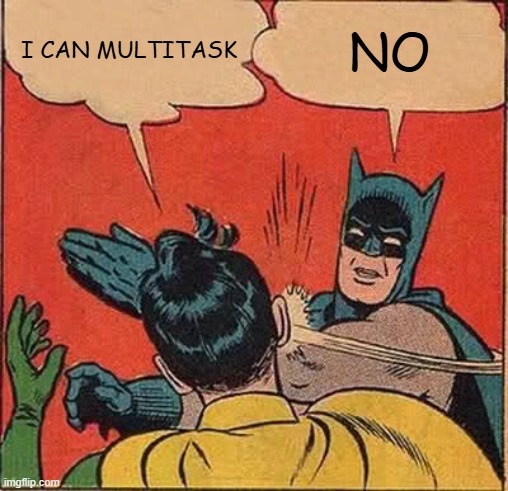
Think You Can Multitask? Think Again

By: Breannyn Dixon

Picture this: You have a test that you need to study for. You get ready at your desk with your textbook and notes to begin studying. Then your phone goes off and before you know it, you are scrolling on TikTok or Instagram while trying to study. Does this sound like you before tests?

In this scenario, you can feel like you are getting a lot more done than you are because you are studying and scrolling or answering friends on your phone. There is a misconception that when you are working through multiple tasks at the same time, or multitasking, you are getting a lot done faster. However, in reality, you are actually less productive. This is called divided attention, and it could be the real reason why you are not able to remember the material you try to study before a big test or final. So how do you avoid falling into the trap of divided attention? We will dive into different solutions for your scrolling time and study time not overlapping. 
Continue reading “Think You Can Multitask? Think Again”

Way of studying; Relating words to survival value

By: Joshua Stanley

Studying for classes or a test can be stressful at times, and prevent you from fully understanding the full material. Even when you prepare for a big exam you may not remember everything you studied and that can lead to an unwanted grade. A way to make your studying easier is by relating words or information to survival value. Doing this will make studying more effective because it taps into how human memory naturally works.

Our brains are wired to prioritise information that seems important for survival, so when something feels relevant to staying alive or solving real-life problems, the brain processes it more deeply and remembers it better. For example, instead of trying to memorize vocabulary or facts you can ask yourself how that information might help you in a real life situation, that way the information comes easier to remember because you related it to a real world experience. Say you were studying biology terms, you should think about how knowing them could help you identify or understand an illness.

Continue reading “Way of studying; Relating words to survival value”

Why Your Brain Loves Words and Pictures: Dual Coding Theory

By Cierra Crady

Introduction

How that works is that we have two brain systems:

  • Verbal System – Words, language, and/or written or spoken information
  • Non-verbal System – Images, mental pictures, and sensory pictures
Continue reading “Why Your Brain Loves Words and Pictures: Dual Coding Theory”

Understanding Versus Memorizing; Why Elaboration Is Better

By: Courtney Hart

Have you ever crammed for a test and immediately forgot what it is you learned afterwards.  This is something I struggled with when first getting into college.  I would study right before a test or some important assignment.  I would get the topic down for the short period of time that I needed it but then when I try to recall it after a longer period. It was hard for me to remember, I used to blame my memory being bad, but I have come to realize it is just the way I was studying that was the problem.  Well, that is because I was not trying to understand the information but just memorize it.  One of the better ways to study is to understand.  And that is exactly what the purpose of elaboration is.  Elaboration is a technique that I learned that has helped me study and succeed within the learning environment. 

Continue reading “Understanding Versus Memorizing; Why Elaboration Is Better”

“Why I Forgot Stuff During the Test After Studying Really Hard” 

By Walter Medrano

Have you ever studied really hard for a test, but when you sit down to take it, your mind just blanks out and you notice that you’re not as confident as you were while studying? That’s happened to me more than once. I’d study in my dorm, feel super confident, and then get to the classroom and suddenly forget everything. I used to think it was just nerves or stress, but it turns out there’s actually a reason this happens, and it’s called the encoding specificity principle. It may sound scary at first but it’s actually pretty cool once you understand it. 

Continue reading ““Why I Forgot Stuff During the Test After Studying Really Hard” “

Studying hard but forgetting fast? Interference might be at fault

By Danika Apostolovich

Introduction

Have you ever wondered why you might have studied hard for an upcoming history exam, making sure you focus on the dates, people involved, and what countries might be involved within a war, just to completely blank and forget all of the details about what you studied when the exam is given out? This is especially frustrating when you know you put in the effort to do well on the test. Let me tell you, in college this especially gets hard when you have to balance so many different things on a daily basis.

Well Did you happen to also study for that spanish test that you have the next period after? As it turns out, the material from studying for that spanish test wound up interfering with your ability to accurately remember what you studied for the history exam.

This post will dive deeper into interference theory, specifically retroactive and proactive interference. So that when you are about to go on to your first semester of college, you can know how to avoid this unfortunate circumstance of forgetting info and instead replace it with better study techniques!

Continue reading “Studying hard but forgetting fast? Interference might be at fault”

How Your Personal Experiences Help You Gain A Better Understanding When Learning Something New

By Raquel Frakes

Introduction

Going to school at any age requires us to learn new things every day. At times, it is hard to remember every topic or concept you have learned. College is a whole different ballgame, where learning and obtaining new information are crucial for our futures. College can be difficult because of other obligations or even jobs, so it is essential to find a successful method to recall information that you have learned. The Self-Reference Affect is one of those successful methods. 

Continue reading “How Your Personal Experiences Help You Gain A Better Understanding When Learning Something New”