
Constantly studying but still lost? Well, organization might be the key to your solution

By: Chloe Pluger

Introduction

Have you ever stayed up hours on end studying: rereading the notes, writing everything down, even pulling an all nighter to open the test and thinking your still going to fail.

It’s very annoying when you know you put all that effort into studying. The issue is though the problem might not be how much you were studying all that information it could be the way you organized what you were learning.

While in college theres so much going on multiple classes, different deadlines, sports, and other responsibilities. Without having a clear schedule all the information you are told could start to come together or you could forget it. Now this is when cognitive psychology comes into play.

This post will be going over how organization affects memory, why your brain relies on structure to process the information, and how you can apply simple, research-backed strategies so you are able to change the bad study habits into more organized and effective ways to recall the information.

Continue reading “Constantly studying but still lost? Well, organization might be the key to your solution”
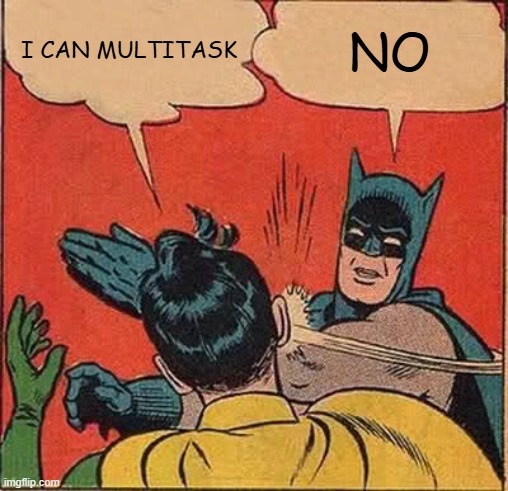


Think You Can Multitask? Think Again

By: Breannyn Dixon

Picture this: You have a test that you need to study for. You get ready at your desk with your textbook and notes to begin studying. Then your phone goes off and before you know it, you are scrolling on TikTok or Instagram while trying to study. Does this sound like you before tests?

In this scenario, you can feel like you are getting a lot more done than you are because you are studying and scrolling or answering friends on your phone. There is a misconception that when you are working through multiple tasks at the same time, or multitasking, you are getting a lot done faster. However, in reality, you are actually less productive. This is called divided attention, and it could be the real reason why you are not able to remember the material you try to study before a big test or final. So how do you avoid falling into the trap of divided attention? We will dive into different solutions for your scrolling time and study time not overlapping. 
Continue reading “Think You Can Multitask? Think Again”

You Think You Understand… But Your Brain Is Guessing: How Top-Down Processing Affects Studying

By: Kayleigh Zerrusen

Introduction

If you were to ask me to travel back to my first semester of college, I would give myself the advice to find a better way to study instead of just looking over notes that I copied and pasted from class. Most students will find themselves spending hours on end looking over notes and reading through textbooks. This tends to lead them to feel unprepared during exams and tests. Students think that this is caused from a lack of effort, but it could be the way your brain is processing information. An important idea from cognitive psychology that explains this issue is top-down processing. This process shows how knowledge that you have been taught previously and other experiences shape the way we comprehend and understand new information. Although top-down processing can be useful, there is also a possibility it can lead to misunderstanding when we study if it is not used the correct way. 

F.1. Although the image is not moving, viewers often perceive spinning motions, showing how the brain uses top-down processing to understand visual information.
Continue reading “You Think You Understand… But Your Brain Is Guessing: How Top-Down Processing Affects Studying”

Understanding Versus Memorizing; Why Elaboration Is Better

By: Courtney Hart

Have you ever crammed for a test and immediately forgot what it is you learned afterwards.  This is something I struggled with when first getting into college.  I would study right before a test or some important assignment.  I would get the topic down for the short period of time that I needed it but then when I try to recall it after a longer period. It was hard for me to remember, I used to blame my memory being bad, but I have come to realize it is just the way I was studying that was the problem.  Well, that is because I was not trying to understand the information but just memorize it.  One of the better ways to study is to understand.  And that is exactly what the purpose of elaboration is.  Elaboration is a technique that I learned that has helped me study and succeed within the learning environment. 

Continue reading “Understanding Versus Memorizing; Why Elaboration Is Better”

“Why I Forgot Stuff During the Test After Studying Really Hard” 

By Walter Medrano

Have you ever studied really hard for a test, but when you sit down to take it, your mind just blanks out and you notice that you’re not as confident as you were while studying? That’s happened to me more than once. I’d study in my dorm, feel super confident, and then get to the classroom and suddenly forget everything. I used to think it was just nerves or stress, but it turns out there’s actually a reason this happens, and it’s called the encoding specificity principle. It may sound scary at first but it’s actually pretty cool once you understand it. 

Continue reading ““Why I Forgot Stuff During the Test After Studying Really Hard” “

Studying hard but forgetting fast? Interference might be at fault

By Danika Apostolovich

Introduction

Have you ever wondered why you might have studied hard for an upcoming history exam, making sure you focus on the dates, people involved, and what countries might be involved within a war, just to completely blank and forget all of the details about what you studied when the exam is given out? This is especially frustrating when you know you put in the effort to do well on the test. Let me tell you, in college this especially gets hard when you have to balance so many different things on a daily basis.

Well Did you happen to also study for that spanish test that you have the next period after? As it turns out, the material from studying for that spanish test wound up interfering with your ability to accurately remember what you studied for the history exam.

This post will dive deeper into interference theory, specifically retroactive and proactive interference. So that when you are about to go on to your first semester of college, you can know how to avoid this unfortunate circumstance of forgetting info and instead replace it with better study techniques!

Continue reading “Studying hard but forgetting fast? Interference might be at fault”

How Your Personal Experiences Help You Gain A Better Understanding When Learning Something New

By Raquel Frakes

Introduction

Going to school at any age requires us to learn new things every day. At times, it is hard to remember every topic or concept you have learned. College is a whole different ballgame, where learning and obtaining new information are crucial for our futures. College can be difficult because of other obligations or even jobs, so it is essential to find a successful method to recall information that you have learned. The Self-Reference Affect is one of those successful methods. 

Continue reading “How Your Personal Experiences Help You Gain A Better Understanding When Learning Something New”

Clarity: Making Sense of Your Mind in College

By Jordyn Coppejans

Elaborate is what we constantly hear. Did you know we have a great elaborate machine in our brain that takes up what we experience and combines it? Our mind reconstructs what we experience and makes it different, but still lets us retrieve the right information for a deeper understanding of knowledge, like collage.


First, let’s dive into Elaborative Rehearsal, which uses meanings and connections to help transfer information to long-term memory. “Generating questions makes you think hard about the material and fosters comprehension (B. Wong,1995). Additionally, answering questions such as “Why is this true? Or what parts of this page are new to me? will help you to learn because it connects what you are learning to what you already know.” (Putnam et al.,2016) Looking at that quote, you can see that comprehension is done by connections and not just by memorizing information.

Continue reading “Clarity: Making Sense of Your Mind in College”

Serial Position Effect- The Middle Child of Memory

By Alyssa Bundren

Think of the last test you took. Was there a question on that test that you could not remember even though you knew it was in the study guide? Was it in the middle of the study guide rather than the beginning or end? This is the Serial Position Effect. As described, the Serial Position Effect is the tendency to remember information from the beginning or the end but to forget information. While this may seem straight forward, it can actually be quite complex and effect people more often than you would think. But do not worry, we’re gonna talk about it.  

Continue reading “Serial Position Effect- The Middle Child of Memory”