Think You Can Multitask? Think Again

By: Breannyn Dixon

Picture this: You have a test that you need to study for. You get ready at your desk with your textbook and notes to begin studying. Then your phone goes off and before you know it, you are scrolling on TikTok or Instagram while trying to study. Does this sound like you before tests?

In this scenario, you can feel like you are getting a lot more done than you are because you are studying and scrolling or answering friends on your phone. There is a misconception that when you are working through multiple tasks at the same time, or multitasking, you are getting a lot done faster. However, in reality, you are actually less productive. This is called divided attention, and it could be the real reason why you are not able to remember the material you try to study before a big test or final. So how do you avoid falling into the trap of divided attention? We will dive into different solutions for your scrolling time and study time not overlapping. 
Continue reading “Think You Can Multitask? Think Again”

Understanding Versus Memorizing; Why Elaboration Is Better

By: Courtney Hart

Have you ever crammed for a test and immediately forgot what it is you learned afterwards.  This is something I struggled with when first getting into college.  I would study right before a test or some important assignment.  I would get the topic down for the short period of time that I needed it but then when I try to recall it after a longer period. It was hard for me to remember, I used to blame my memory being bad, but I have come to realize it is just the way I was studying that was the problem.  Well, that is because I was not trying to understand the information but just memorize it.  One of the better ways to study is to understand.  And that is exactly what the purpose of elaboration is.  Elaboration is a technique that I learned that has helped me study and succeed within the learning environment. 

Continue reading “Understanding Versus Memorizing; Why Elaboration Is Better”

Not You Getting Distracted Again… 

By: Mason Johnson 

Introduction 

You know those days where you tell yourself you’re going to be super productive, get all your work done, and finally stay focused… and then somehow you end up doing literally anything else? Yeah, same. 

You sit down, open your laptop, maybe even have a snack ready, and within minutes, you’re checking your phone and giggling at random videos you didn’t even mean to tap on. Being a first-year college student is already a big adjustment, and trying to stay focused on top of that can feel impossible. 

Continue reading “Not You Getting Distracted Again… “

Why You Suck at Studying… And How to Fix It: The Hidden Problem of Cognitive Interference

By: Nate Talkad

You know that feeling when you’ve been studying for hours and hours the night before your exam, and you’re feeling prepared, and then you show up and think to yourself, “I have never seen any of this in my life”? It can be quite frustrating, confusing, and frankly a little demoralizing. But here’s the thing: your brain isn’t full of cobwebs, it’s just a little confused due to something called cognitive interference. A sneaky, everyday memory blunder that affects not just college students, but every single human without them even realizing it.

Cognitive interference happens when different memories compete with each other. Think of it like trying to listen to two people talking to you at the same time. You may catch some words from one person and some from another, and by the end of it, you’re left confused and not knowing what either of them were talking about. The same thing happens in your mind when old and new information overlap.

Understanding this phenomenon can completely change the way you study and scrape through your classes. let’s dig into what interference is, how it shows up in real life, and what the research says you can do to fix it.

Continue reading “Why You Suck at Studying… And How to Fix It: The Hidden Problem of Cognitive Interference”

Load Theory of Attention: The Ultimate Theory to Success

By Bailey Newhouse

Intro:

Have you ever noticed that, when you are working on a tough homework assignment, the world shuts down around you? You become hyper-focused on the task in front of you that you barely register someone coughing a few feet away from you or the sound of music playing through your headphones. However, when you pull out your phone and start watching Tik Tok, suddenly every single noise is audible. The person talking loudly across the room, the sound of someone getting out of a chair, the person coughing from early, all of it begins to distract you from your daily doom scroll. Why is that? Well, you may be experiencing something called load theory of attention, and when it comes time to study for those college exams, it may be something you want to be aware of.

Continue reading “Load Theory of Attention: The Ultimate Theory to Success”

The Power of Lo-fi Beats

By Eli Dew

Introduction

Music is an innately human practice. From the humming the song that is stuck in your head to walk out songs to specific life and cultural moments, such as the quinceanera or weddings, music can serve a variety of purposes. In a recent study, researchers found that over fifty percent of college students’ study and do other classwork while listening to music1. This largely due to music through platforms like Spotify making music much more accessible. Music is a powerful form of self-expression, but can music help you be better at school? 

Continue reading “The Power of Lo-fi Beats”

Focus Like a Pro: How Selective Attention Can Help You Become a Superior Studier

By Matthew Baird

Many people have said that you must go to college to get the “college experience,”  

which would open you up to new opportunities and material that would help fulfill your dreams in life. 

Over the years I have recognized this fantasy and replaced it with a more “real” outlook on college.  

Deadlines lurking around every corner,  

A new assignment posted every hour,  

A forgotten project pushed to crunch time.  

In short, the college experience has been extremely overwhelming and tough, but there is no reason to fear it because there are many ways in which you can drastically increase your attention ability.  

We will look at a particular psychological concept in this paper, that can improve your cognition and daily functioning [1], and help you grasp the most important information for studying. This concept is known as selective attention, and it works as our brain’s built-in thought filtration system. 

Continue reading “Focus Like a Pro: How Selective Attention Can Help You Become a Superior Studier”

Split Focus, Sinking Grades: The Truth About Divided Attention

By Navada Roberts

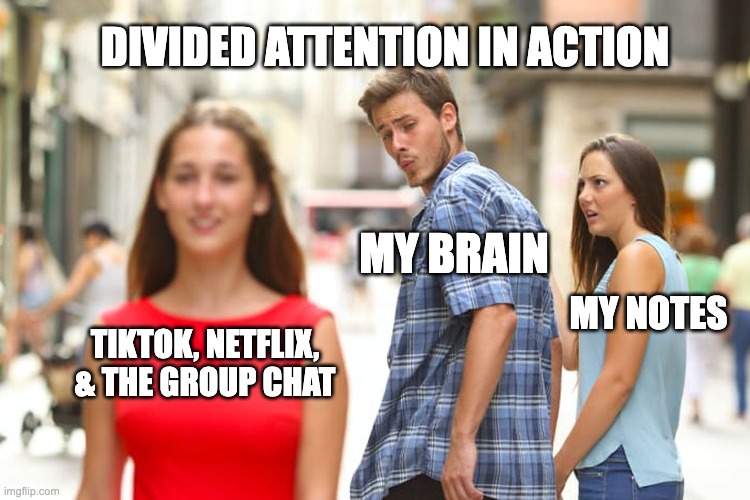
Imagine, you’re getting prepared to study for your next exam. You have your textbook open, your notes are ready, but you’re watching a TikTok on your phone. Or maybe you have a Netflix show on in the background for some “background noise”. Does this scenario sound a little familiar?

It may feel like you’re being productive because you’re multitasking multiple things at the same time, but in reality, cognitive psychology says otherwise. You’re not actually multitasking; you’re performing something called divided attention and it might be the reason why your study sessions aren’t as useful as you expected them to be. Don’t worry though, in this post I will discuss what you can do to balance your study and TikTok time.

What is Divided Attention?

Divided attention occurs when you try to focus on more than one task at a time. It splits all your mental energy between multiple tasks, unlike focused attention, where all your mental energy goes to one task. Your brain isn’t designed to completely process multiple tasks at once. Instead, it switches between the tasks, resulting in something called the switching cost. The switching cost is when you lose time, make more errors, and overall remember less information [1]. Research shows that even small distractions, like your phone buzzing or music playing in the background, can affect how you store information in your memory [2]. This is true when it comes to studying, because the more divided your attention is, the harder it is to understand and remember the information you’re learning. So next time you think that multitasking will save time, remember that it’s most likely the opposite.

Continue reading “Split Focus, Sinking Grades: The Truth About Divided Attention”

Unlocking your brain’s power: The secret to easier studying

By Isabella Carbajal

For first-year college students, the transition from high school to college can be challenging, especially when the ways of studying and learning begin to change. Luckily, there are beneficial ways of improving and overcoming these challenges if we understand the concept of load theory of attention. Do not fear, it is not as complicated as it may seem, and will change the way you think about studying!

Continue reading “Unlocking your brain’s power: The secret to easier studying”

SQUIRREL! (Understanding Selective Attention)

By Lydia Clark

Introduction

Have you ever sat down to do homework, study, or to focus on a topic and realized that it is difficult to ignore distractions around you? Have you ever wondered why it is so difficult to filter out distractions, even though you desire to be productive? At several points in a student’s academic career, most people often struggle with truly remaining focused while doing schoolwork and other important tasks. There can be many aspects of why a student cannot stay focused, especially if they are preoccupied with other events in their life. 

What is Selective Attention?

One main reason that students can become so easily distracted is that selective attention is an obstacle that every student faces. Selective Attention is the process of having an ability to focus on a particular subject in their direct environment for a specific amount of time. For a student to be truly productive with their work, they must put in effort with this process and actively ignore all other distractions around their working environment. For this process to be a success, a person must be selective in their own attention and realize what they must drown out in the background. For a lot of young people, it can be a challenging task to drown out distractions such as their phones or other technology that is not helpful to be used in the moment.  

Continue reading “SQUIRREL! (Understanding Selective Attention)”