It is easy to fall victim to procrastination and decide to cram a study session right before an exam. Procrastinating will only give you mediocre scores and a whole Lotta stress. Our brain can memorize information much more successfully when studying is spaced out across hours, days, or even weeks. Studying too much over a short period can lead to overstimulation of neurons and mental fatigue. If you want to get great exam scores while still being able to go out and enjoy yourself try out the spacing effect. Even if you only study for ten minutes every day for a week, you’ll have more success in memorizing the implementation than you would if you studied for two hours only once. You don’t have to give up your weekends to succeed.
Do you want information to process better and stay in your LTM (Long Term Memory)? Well, all you have to do is follow the Levels of Processing Theory. The Levels processing Theory says the depth of processing information has a big impact on how well it is remembered.
What Is Levels of Processing Theory?
Levels Processing Theory is the theory that assumes that deeper, more meaningful engagement with information leads to better memory retention compared to shallow processing that focuses on surface details. It is also the idea that the way information is encoded affects how well it is remembered. The deeper the level of processing, the easier the information is to recall. With Levels of Processing Theory, there is some Circular reasoning, in the context of levels of processing, refers to the flawed argument where the premises are used to support the conclusion, and the conclusion is also used to support the premises, creating a loop without providing independent evidence for either.
Do you struggle remembering everything discussed in the presentation throughout the lecture? You’re not alone. Let’s take a closer look, using the Narrative Rehearsal Hypothesis, at how translating your study notes into stories can aid in improving your information retention skills.
What is Narrative Rehearsal Hypothesis?
The Narrative Rehearsal Hypothesis makes it that we are able to remember events more easily when we place them into a narrative consistent with the events. This is because the story makes the events more memorable. Taking advantage of the fact that our minds naturally like to work with and memorize information that is presented in story format, this technique takes advantage of our natural instincts. You will need to translate your study material into a narrative. You’d rather concentrate on identifying the central ideas or themes that are contained in the material you are reading and not on memorizing certain facts. This will enable you to comprehend the material better.
Build a Narrative:
1.Apply new information to a story that you are currently telling.
2.If the story you are telling is more imaginative and stimulating, your memory will be better at remembering the information you are telling.
3.Incorporating the feelings is important simply because our brains can remember things that have emotions behind them better. Trying to include feelings in your tale is something that you should attempt to do if you wish it to be remembered better.
4. Rehearsing the story, as it helps to make your memories and your brain become more strongly linked, remembering the story and telling it to yourself a few times is an effective way of strengthening these links.
If you also wish to explain the ideas to another individual, you can tape yourself and listen back later.
Examples from Out in the Real World
Studying the American Revolution? Instead of memorizing dates and names, you can spend time building a story that is centered around important people and events. Imagine, for example, that George Washington is a stubborn hero who is faced with challenges, and that each one of those challenges is a turning point along his journey to independence.
The Current Evidence Served by Science
It has been demonstrated through the application of research that narrative rehearsal is a powerful means of improving memory. The outcome of a study carried out by Gagnon and Dixon (2008) discovered that the implementation of collaborative storytelling resulted in improvement in the ability of the participants’ to recall information.
The More General Advantages Outside of the Examinations
The goal of the Narrative Rehearsal Hypothesis is not limited to just enhancing your performance on tests. Instead, it can enhance your overall learning and your ability to retain information. What you are doing is taking the information and converting it into stories. By utilizing this method, learning is made more fun and less overwhelming.
Final Thoughts
In the end, learning does not have to mean staring blankly at a pile of flashcards or rereading the same notes over and over. By turning your study material into stories, you’re not just memorizing, you’re challenging your brain more deeply and more meaningfully. The Narrative Rehearsal Hypothesis reminds us that our brains are wired to remember stories, especially when we rehearse them with emotion and structure. So the next time you’re cramming for a major test, give it a try. It might be the lifesaver you need to get learning to work better, and even kinda fun.
Gagnon, L. M., & Dixon, R. A. (2008). Remembering and retelling stories in individual and collaborative contexts. Applied Cognitive Psychology, 22(9), 1275–1297. https://doi.org/10.1002/acp.1437
Piroelle, M., Guette, C., & Abadie, M. (2024). EXPRESS: The Role of Articulatory Rehearsal in Short-Term False Memories during Aging. Quarterly Journal of Experimental Psychology. https://doi.org/10.1177/17470218241269320
Introduction You’re feeling on top of a course- You don’t need to do anything else, procrastinating on studying before the night of an exam because it’s easy to remember. You feel the answers coming to you so easily, and feel on top of the world…and then the grade comes back, and it’s a D. How does this happen? You look at the course material, and realize tiny differences here and there. Sometimes you might recall these differences, and inwardly sigh for not remembering them in the moment, but other times you might not even recall seeing this information. This effect is called the misinformation effect. A method in which the brain tricks itself over time, with the original memory of happenings being distorted by new experiences.(4) It sounds wide-ranging, and it is.
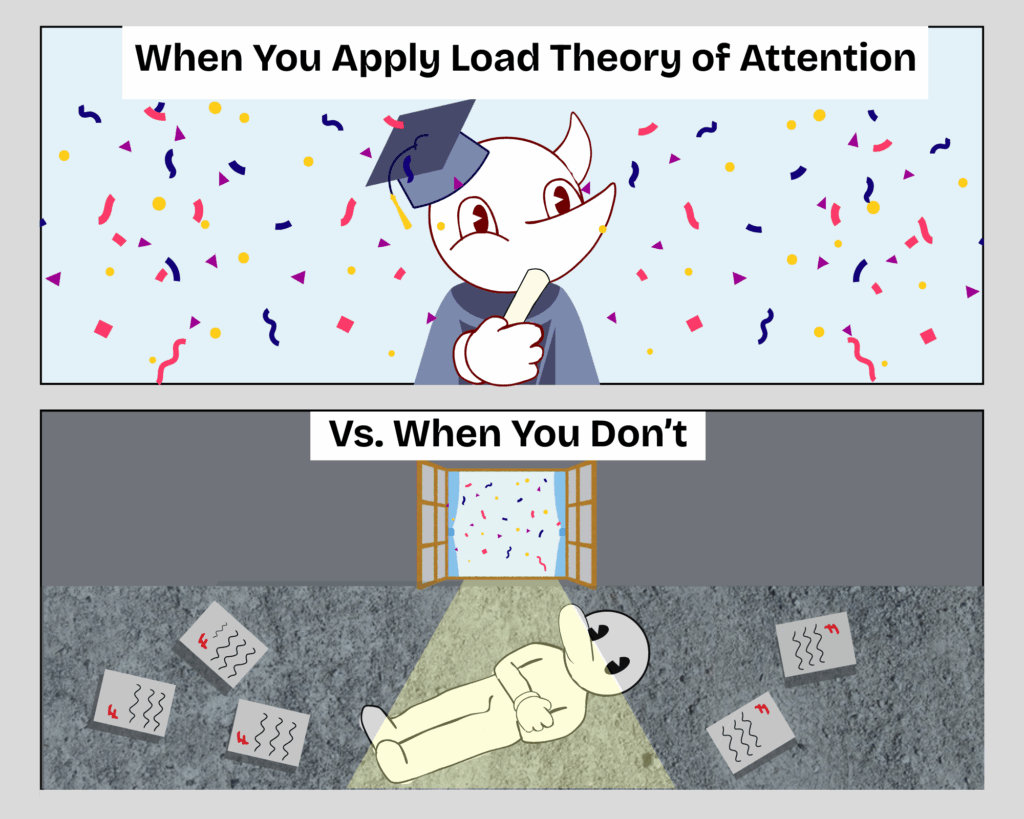
Have you ever noticed that, when you are working on a tough homework assignment, the world shuts down around you? You become hyper-focused on the task in front of you that you barely register someone coughing a few feet away from you or the sound of music playing through your headphones. However, when you pull out your phone and start watching Tik Tok, suddenly every single noise is audible. The person talking loudly across the room, the sound of someone getting out of a chair, the person coughing from early, all of it begins to distract you from your daily doom scroll. Why is that? Well, you may be experiencing something called load theory of attention, and when it comes time to study for those college exams, it may be something you want to be aware of.
“Survival of the fittest” is that old saying that goes on to describe that whoever comes out on top is guaranteed to survive and thrive. Adaptation is what we have to do to ensure the best outcome for survival, and it is not always a physical obstacle. Sometimes our memory is the reason we are able to come up with the survival strategies to adapt to our surroundings. This is called the survival and adaptive value, also known as survival processing and adaptive memory. So, what is survival processing and adaptive memory? Why does this pertain to our everyday lives, and why is it so valuable? Well, we all like to survive and live on to the next day. And, we all adapt to new obstacles everyday, but how much of that would you believe stems from our memory? So is it really “survival of the fittest” or survival of the best memory?
The start of your college career! You made it a step further in your educational journey and now begins the real fun. You have most likely faced a number of problems that you have needed to solve along the way. Spoiler alert: You are going to face more! While you step into this new realm, you are undoubtedly going to come across more obstacles. Don’t worry, because I’ll give you some insight (wink wink) into a great way to solve the problems you’re going to come across. This method is called Gestalt problem solving and before you think to yourself what the sigma is that, I’ll tell you. Gestalt problem solving is reorganizing or thinking about the problem in a different way so you are able to come to that “lightbulb” moment you so desperately desire (1).
Have you ever wondered why some teachers or professors will use real-world situations or concepts to explain certain topics? You could say that it’s because they aren’t great at explaining concepts in class, and had no better way to drive home a point. But in reality, they are using concrete examples to amplify your learning experience, make the lesson memorable, and fill in the gap between hard-to-grasp concepts and reality. So, what are concrete examples, really? Concrete examples are specific, real-life examples (or tasks) that help to illustrate an idea or concept (2). Concrete examples are an extremely powerful tool that will help turn abstract ideas into tangible concepts that are easier for students (or anyone) to grasp. There are multiple advantages to using concrete examples to supplement your studying and aid the learning process (5).
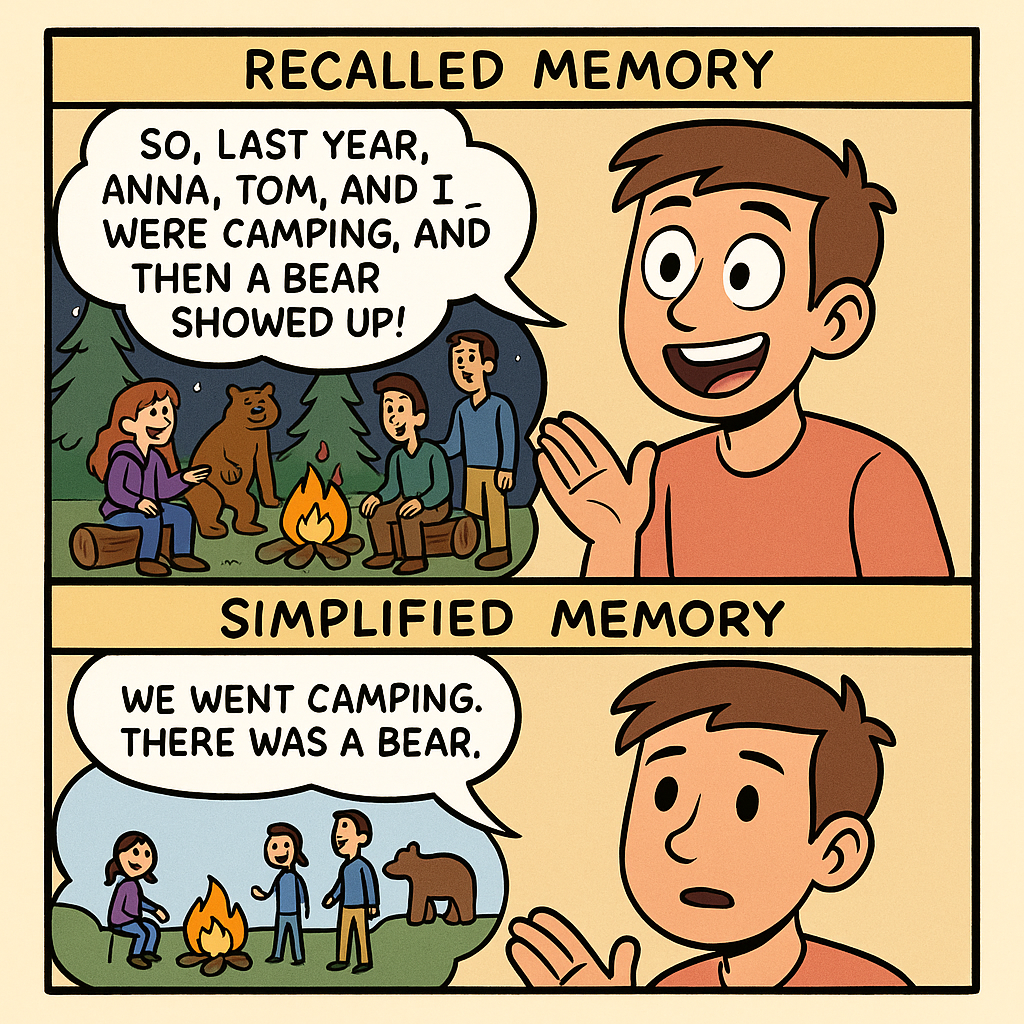
Have you ever told a story and had a fiend stop you in the middle and say ” wait, that is not what happened?” You are not the only one. Our memories are strong, yet they are also imperfect. When we remember something, we are not replaying a flawless, put in order video. Instead, we are reconstructing bits and pieces from our memory and some times we leave parts out. This is known as leveling.
Leveling is a type of memory distortion where people unconsciously leave out minor or less important details while remembering or retelling an event¹.For example, imagine your brain pressing the TL;DR (to long, don’t read) button when you try to recount a story. Let’s assume someone tells you about a wild weekend excursion where they met three individuals from various nations, tried a meal they couldn’t pronounce, and ended up traveling in a truck bed under the stars. You might relate it as: “They met a bunch of people and had some food and a crazy night.”
leveling is one of three memory distortions, the other two being sharpening and absorption. Sharpening emphasizes or exaggerates crucial aspects, while assimilation changes memories to meet our expectations, leveling is all about simplification²
When does it start?
Leveling begins in childhood. When children learn to recall and explain events, they frequently omit specifics and focus on the broad picture. This is not laziness; it is how cognitive development occurs. Our brains learn to prioritize relevance over completeness³. As we mature, this behavior becomes ingrained in how we store and access a wide range of information, from personal recollections to academic content. In fact, researchers believe leveling is a product of schema-based memory. Schemas are mental frameworks we use to understand the world. When something doesn’t fit a schema, we’re more likely to forget it or reshape it to fit our expectations⁴. In this way, leveling becomes a tool for our brain to make sense of complex, confusing life events.
My research
One of the most famous studies on memory and leveling comes from Frederic Bartlett’s 1932 experiment, The War of the Ghosts. In the study, British participants read a Native American folktale filled with unfamiliar cultural references. When asked to recall the story later, they tended to simplify it, leave out foreign elements, and change details to make it more familiar⁵.
This demonstrated that memory is not a perfect recording, but rather a reconstruction. Leveling helped participants remember and recount the tale more easily, but it also generated distortions.
How to use leveling to study
When you’re studying for a huge test or trying to remember knowledge from a lecture, your brain will naturally strive to simplify it. This can be useful—you could compress a lengthy paragraph into a brief summary that is simpler to recall. However, if you level too much, you risk missing out on important information.
Assume you’re studying psychology and learning about classical conditioning. If you remember that it contains dogs and bells but overlook the fact that the unconditioned stimulus and reaction are part of the main process, your knowledge will be incomplete.
According to cognitive research, students often level material in ways that hurt comprehension, especially when dealing with unfamiliar or complex topics⁶. In fact, when students (me as well) take notes, they frequently simplify too much, leaving out essential information that would otherwise help them appreciate the big picture.
Study smarter
Here are some tips to help study better ( Ive started to use some of these myself)
Review regularly. When you go back to your notes or readings, you’ll catch any details that your brain might’ve “leveled out” earlier.
Use self-explanation. Try teaching a concept to someone else. If you find you’re oversimplifying, revisit the material.
Create concrete examples. Just like in math or history classes, using specific real-world scenarios helps you remember more than just the gist.
test yourself. Practice questions that force you to recall deeper details, not just the broad strokes.
real world example of leveling while you’re learning
imagine a law student learning about the United States Supreme Court. Reading briefs, delivering oral arguments, collaborating, and writing opinions are all part of the process. However, after a few weeks, the student recalls it simply as “The Supreme Court decides big cases.” That’s leveling: they preserved the overall notion but removed the individual steps.
While the reduced approach may aid in general knowledge, it will not suffice to answer an exam question that requires the entire process. This demonstrates why understanding levels is especially beneficial for students: you can utilize simplification to your advantage if you know what the original concept looked like.
lets end this thing
Leveling is a memory shortcut that allows us to condense complex experiences, but it can also lead to forgetting or misinterpreting the finer details. From childhood to adulthood, our brains typically remove elements to make stories simpler to remember and share. However, when it comes to studying and learning, we must realize when we are oversimplifying.
Whether you’re studying for an exam or simply trying to comprehend new material, being conscious of levels allows you to become a more strategic learner. Consider this analogy: leveling is similar to film editing. If you remove the wrong scenes, the entire story may lose its meaning.
So, the next time you respond, “I kind of remember that,” take a moment to consider what your brain may have missed.
Schacter, D. L. (1999). The seven sins of memory: Insights from psychology and cognitive neuroscience. American Psychologist, PubMed
Loftus, E. F. (2005). Planting misinformation in the human mind: A 30-year investigation of the malleability of memory. Learning & Memory,PubMed
Fivush, R., & Nelson, K. (2004). Culture and language in the emergence of autobiographical memory. Psychological Science,SAGE Journals
Alba, J. W., & Hasher, L. (1983). Is memory schematic? Psychological Bulletin
Bartlett, F. C. (1932). Remembering: A Study in Experimental and Social Psychology. Cambridge University Press. APA PsycNet
Kiewra, K. A. (1985). Investigating note-taking and review: A depth of processing alternative. Educational Psychologist,Taylor & Francis Online
Many people have said that you must go to college to get the “college experience,”
which would open you up to new opportunities and material that would help fulfill your dreams in life.
Over the years I have recognized this fantasy and replaced it with a more “real” outlook on college.
Deadlines lurking around every corner,
A new assignment posted every hour,
A forgotten project pushed to crunch time.
In short, the college experience has been extremely overwhelming and tough, but there is no reason to fear it because there are many ways in which you can drastically increase your attention ability.
We will look at a particular psychological concept in this paper, that can improve your cognition and daily functioning [1], and help you grasp the most important information for studying. This concept is known as selective attention, and it works as our brain’s built-in thought filtration system.
ID used to identify users for 24 hours after last activity
24 hours
_gat
Used to monitor number of Google Analytics server requests when using Google Tag Manager
1 minute
__utmx
Used to determine whether a user is included in an A / B or Multivariate test.
18 months
_ga
ID used to identify users
2 years
_gali
Used by Google Analytics to determine which links on a page are being clicked
30 seconds
__utmb
Used to distinguish new sessions and visits. This cookie is set when the GA.js javascript library is loaded and there is no existing __utmb cookie. The cookie is updated every time data is sent to the Google Analytics server.
30 minutes after last activity
__utmc
Used only with old Urchin versions of Google Analytics and not with GA.js. Was used to distinguish between new sessions and visits at the end of a session.
End of session (browser)
__utmz
Contains information about the traffic source or campaign that directed user to the website. The cookie is set when the GA.js javascript is loaded and updated when data is sent to the Google Anaytics server
6 months after last activity
__utmv
Contains custom information set by the web developer via the _setCustomVar method in Google Analytics. This cookie is updated every time new data is sent to the Google Analytics server.
2 years after last activity
_gac_
Contains information related to marketing campaigns of the user. These are shared with Google AdWords / Google Ads when the Google Ads and Google Analytics accounts are linked together.
90 days
__utma
ID used to identify users and sessions
2 years after last activity
__utmt
Used to monitor number of Google Analytics server requests