
Concrete Examples
By: Hannah Jachimiak
Why Do I Experience This After A Lecture?
I think we all have experienced attending a lecture, taking word for word notes, and thinking you have a common understanding of what is being discussed; only to have all that information go in one ear and out the other. In those last few minutes before the lecture ends you might have a solid understanding of the information discussed due to staying engaged with the professor’s lecture. Although you understand and retain the information while the lecture is actively happening, as soon as your professor ends the lecture it becomes extremely difficult to utilize the material that was taught. This tends to happen after a lecture because your brain is trying to retain mass quantities of information that is often lectured with abstract examples.
What Are The Differences In Abstract Examples vs. Concrete Examples?
You may be asking yourself, what is an abstract example? Well abstract examples are connections that aren’t true to real life situations and that’s why your professors lecture just goes in one ear and out the other ear. You might be saying to yourself “well I take notes” that’s not the reason why you’re not retaining the information. You can write down every single word and all the definitions on each of the slides during the actual lecture but unfortunately without connecting the notes to any real life personal event, not all the information will be fully processed enough for that information to stay in your brain. Research shows that the teaching of abstract concepts in psychology could be helped by frequent use of concrete, real-world examples (Micallef & Newton, 2024). These professors are very far in between but if you can get a professor that uses concrete examples during his/her lecture then you will be golden. Concrete examples are those personal connections and real life situations that give more of a background to the concept that is getting taught. The Learning Scientists (2017) explained the idea is to take an abstract concept and use real world examples to increase understanding. The difference is when you have a professor that uses concrete examples it’s not necessarily all about taking word for word notes during the lecture but it’s how the connections are understood. In Research School UK (n.d) noted that many of the concepts we teach are fairly abstract in nature, and in seeking to help students understand them we can exploit the dynamic between new and existing knowledge by using a concrete example. When lecturing using concrete examples the professor has to develop a way to teach using examples that are relevant to us and our day and age. Getting lectured with concrete examples not only allows for the information to fully develop in our brains but also connects the information in a more meaningful way.
How Do Concrete Examples Actually Work?

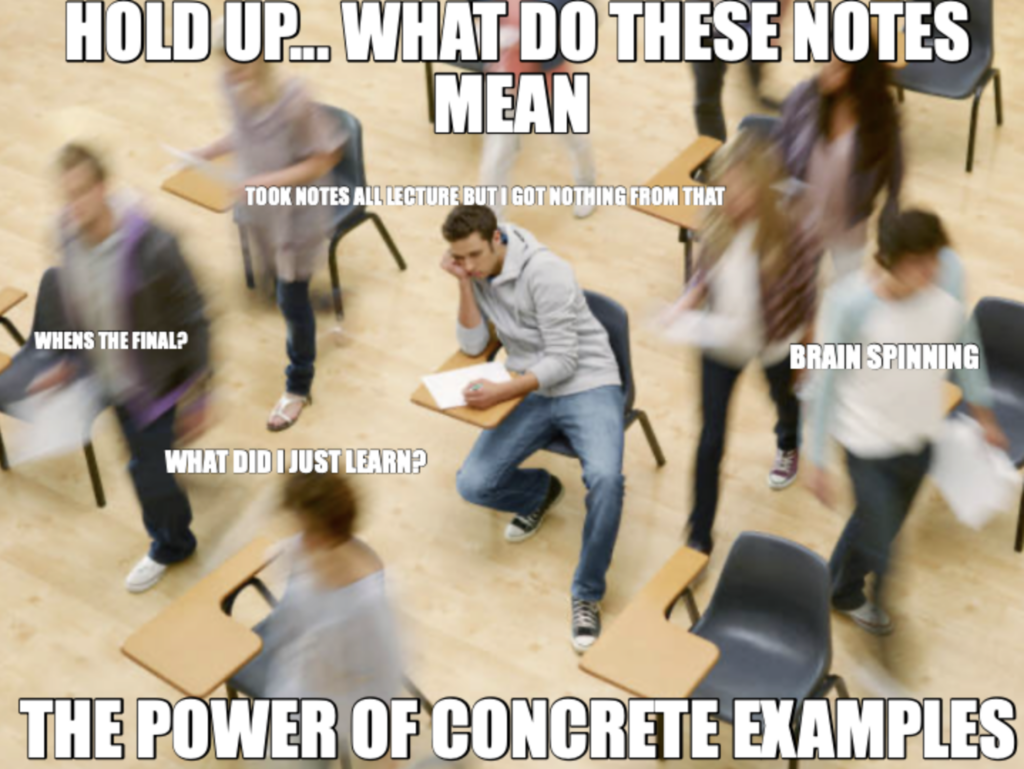
The meme above capitalizes on how an abstract example can be received and interpreted differently for some students. Without the use of concrete examples there would be no real life examples and students wouldn’t understand correctly. The usage of concrete examples allows for the brain to easily reach the stored information as that the information is easier to recall.
Benefits To Using Concrete Examples (5):
- Better understanding of abstract examples
- Strengthens memory
- Gets students involved in class
- Helps all different types of learns
- Real life application
Concrete examples are used to better support incoming freshmen due to how the information is strengthen based on how the brain receives it. Our brains do better with concrete examples due to encoding, this is how the information just learned is stored away in your memory. When we get taught a piece of information that is real and meaningful our brains do encoding, this is when the brain takes what is being processed from what was going on around you when you learned this information and altering it so that your brain can properly store it away. In Day, Motz, and Goldstone (2015) stated that prior research has established that while the use of concrete, familiar examples can provide many important benefits for learning Another beneift of concrete examples is the actually learning aspect of how much easier it is to actually understand, recall, and use in everyday life. The strongest benefit is how much concrete examples help students just like yourself understand abstract ideas by turning them into real life connections. In Day, Motz, and Goldstone (2015) study informed readers that maintaining student attention and engagement is a constant concern, and research shows that more concrete materials tend to increase student interest (Sadoski et al., 1993). Concrete examples increases memory due to the resemblance in the lecture examples to everyday life, making the brains job easier to store and recall at a later time. While concrete examples improves memory it also helps retrieval, which basically is just the act of remembering something. When ideas from a lecture are related back to known situations, us students use something called memory cues to help fish out that information from storage. Overall, concrete examples are used to better support students once they sit through a lecture, to better remember the lecture in a more vivid way. As stated by Megan in Nebel (2017) an important feature of using examples is that the surface details need to vary or students will pay attention to these details and ignore the underlying meaning.
Conclusion
Overall, the idea of using concrete examples within lectures allows for a clear, higher engagement, and just makes the chances of remembering higher. Having concrete examples also helps the brain turn an abstract example into something more powerful with a real life situation or experience. Teaching with concrete examples instead of abstract changes those students like myself who say “woah I have no clue what have I just learned” into students that are able to connect an abstract example into a concrete example.
References:
Day SB, Motz BA and Goldstone RL (2015) The Cognitive Costs of Context: The Effects of Concreteness and Immersiveness in Instructional Examples. Front. Psychol. 6:1876. doi: 10.3389/fpsyg.2015.01876 https://www.frontiersin.org/journals/psychology/articles/10.3389/fpsyg.2015.01876/full?amp;utm_campaign=detangling-similar-concepts%5C&utm_medium=referral
Micallef, A., & Newton, P. M. (2024). The Use of Concrete Examples Enhances the Learning of Abstract Concepts: A Replication Study. Teaching of Psychology, 51(1), 22-29. https://journals.sagepub.com/doi/10.1177/00986283211058069
Learning Scientists. (2017, August 20). Weekly digest #73: Concrete examples in the classroom —. The Learning Scientists. https://www.learningscientists.org/blog/2017/8/20/weekly-digest-73 https://www.learningscientists.org/blog/2017/8/20/weekly-digest-73
(N.d.). Org.uk. Retrieved May 1, 2026, from https://researchschool.org.uk/durrington/news/research-bites-concrete-examples https://researchschool.org.uk/durrington/news/research-bites-concrete-examples
Nebel, C. (2017, August 24). Do concrete examples hinder learning? —. The Learning Scientists. https://www.learningscientists.org/blog/2017/8/24-1 https://www.learningscientists.org/blog/2017/8/24-1
Hi Hannah, your explanation of why lectures can be clear at first but hard to remember later really makes sense. I think you’re right that using concrete examples helps to connect abstract ideas to real life situations, making it easier for people to understand and remember the information. What you’re saying is that when we learn through real-world examples, it’s more effective than just being taught abstract concepts. Your point comes across really clearly, and it’s easy to see why using everyday examples can make a big difference in how well we retain information.