How to keep your memory fresh with Maintenace Rehearsal

By Nshimirimana Ezechiele

Introduction:

When you first enter college life becomes a whirlpool of lectures, assignments, quizzes, and exams. In the midst of all of that chaos you have to continuously attempt to retain large amounts of information for things such as a quiz, an essay, or an exam. Although there are many ways to go about remembering one of the techniques that can be used is Maintenance Rehearsal.

What is Maintenance rehearsal?

Maintenance rehearsal is pretty much as its name suggests. It is the process of repeatedly rehearsing information in a short-term memory without any meaningful processing or connections to existing knowledge” [1] The Atkinson and Shiffrin memory model describes it best as something that simply roams in your head till it is time to use it. An example of this includes things like remembering a phone number regardless of how bad you want to keep it in your head most likely after it’s served its purpose you won’t remember it much after [2]. This is part of the phonological loop and is seen as the first step which is taking verbal information in and keeping it in your head temporarily before it gets lost or is stored [3]. Along with that while preparing for a test normally one will repeat the information to retain it just long enough to pass the test, after that the knowledge is like it never existed.This skill is used by pretty much everyone at some point in their life but now more than ever you may find yourself needing it.


Continue reading “How to keep your memory fresh with Maintenace Rehearsal”

Break It Down! Master Studying with Chunking!

By Lexi Liptak

Just found out you have an exam coming up soon? Need a new way to study to keep your focus? There is a simple trick to help you instead of cramming and rereading the information for hours. It is called chunking! Chunking helps you break down course material into more manageable pieces to help you remember. We will be diving into how this works and how to help you study a lot smarter!

What is Chunking?

Chunking is a strategy where you take information and break it up into smaller pieces to help your brain remember the information.1 Chunking can help you remember things in smaller quantities instead of memorizing everything at once. Think about it when you were younger trying to remember your mom or dads phone number. You learned the phone number in chunks not all at once. Everyone uses chunking without even realizing it. Why not use it to get that good grade on your next exam.

Continue reading “Break It Down! Master Studying with Chunking!”

The Simple Study Hack College Freshmen Can Use To Boost Their GPA!

By Craig Jamieson

If you’re a college freshman, I hate to break it to you but college level courses aren’t as easy as high-school classes.

Your high-school teachers spent weeks slowly covering basic concepts, making surface level information easy to learn

But college is different…

Professors break down complex topics at a fast pace, while expecting you to learn more in less time… 

And from my experience as a college senior, most freshmen use inefficient study tactics that prevent them from gaining a deep understanding of class material. 

If you spend hours upon hours rereading the same notes and highlighting texts, while your grades suffer…

YOU’VE COME TO RIGHT PLACE!

Continue reading “The Simple Study Hack College Freshmen Can Use To Boost Their GPA!”

Study Until you are…AWARE

By Bailey Poignant

Introduction

Studying for college exams can be stressful and scary especially when you do not know what to study, or how to know what information or material you should be reviewing. Not knowing what to study or how to study can cause students to not get the best results from reviewing, or completely avoiding it altogether because it does not help. When studying do you ever think back to see if you can recall the information? Knowing what you will be able to recall is known as metamemory. Using metamemory you can estimate how well you will be able to remember something, or judge how well you will be able to bring it forward when that information is needed. Maybe sometimes you have studied, and when you are given the exam you cannot quite pull the information forward that you know is in there somewhere. This is also metamemory. 

Continue reading “Study Until you are…AWARE”

Cracking the (En)Code

By Claire Schaffner

Introduction

Hey, there! If you’re reading this, then you are probably a first-year college student overwhelmed during syllabus week and thinking: “There is no chance I survive freshman year.” You’re thinking back to high school and reminiscing on how easy your classes were and how you spent nights before tests (when they were still called tests, and not “exams,” which is somehow much more intimidating), which you spent playing Fortnite, not cramming a semester’s worth of content in preparation for a final. Your high school teachers, parents, freshman orientation leader, and probably your TikTok “For You Page” have all most likely thrown a lot of studying hacks and advice at you, but you may still feel unprepared for the courseload you’re taking on, and unsure of how you’re going to balance 16 credit hours, Greek life, homesickness, and a social life. Do not fear! Here is a quick and simple guide on how to understand use the psychological concept of encoding to get the most out of your studying. Happy reading! Good luck with your freshman year!

Continue reading “Cracking the (En)Code”

Taking breaks while studying? Who knew studying could be this easy

By Kloe Norris

Introduction 

When people first get to college, most kids do not know how to study. Some kids come into college homeschooled, some did not go to a public school while others went to a school where they did not have to study for hard tests/exams. Incoming freshmen wanting to go to college are blindsided when it comes to how much studying really affects how well someone does in college. Coming to college has made me realize how much studying you have to do. Knowing how to study the right way is something that has helped tremendously while being in college. College is a scary thing but knowing how to study the right way and pass your classes will make college so much easier in the future. 

The Spacing Effect and how it works

Just hearing the word Spacing effect when it comes to studying may scare some students off and they will probably look past it like it is nothing, but it is very important. The Spacing Effect, when it comes to studying, is one of the earliest discoveries in human learning (1). It is proven that if a student spaces out their studying and processes what they are learning, they will remember and learn the information and memorize it better (1). For example, if you have a big exam coming up, it is better for you to take breaks throughout the time you are studying to help understand the information more. 

Continue reading “Taking breaks while studying? Who knew studying could be this easy”

Reach for the Stars…and Your Homework

By Chloe Smith

Introduction

There are days where it is hard to make yourself get out of bed, go to school, or complete an assignment, but these are tasks that need to be completed in order for success. Every student is responsible for their own success, and this includes having goals and doing things we may not want to do to reach those goals. Being a first-year college student can be intimidating in itself, and you may wake up one day and ask yourself, “Do I really want to go to class today?” You may enjoy lying in bed all day catching up on your favorite TV show, but you must control those thoughts and make the choice that will ultimately benefit you in the long run. By overriding these thoughts and still getting up to go to school to achieve your goals you are participating in the use of cognitive control and self-regulation.

Continue reading “Reach for the Stars…and Your Homework”

One at a Time: The Hidden Power of Singular Focus

By Gabrielle Penberthy

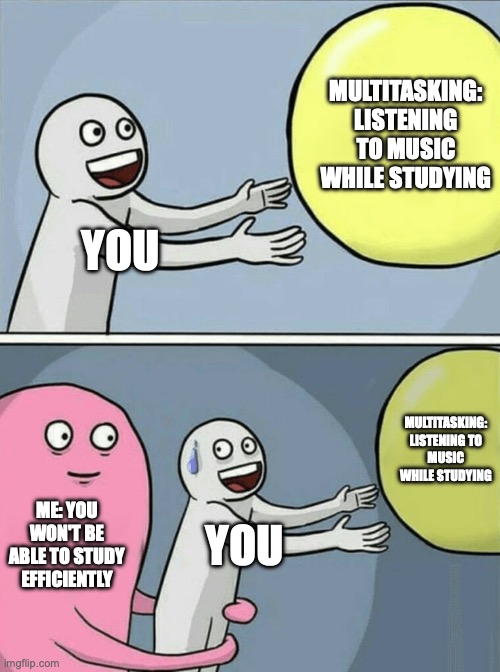
Running Away Balloon Meme | MULTITASKING: LISTENING TO MUSIC WHILE STUDYING; YOU; MULTITASKING: LISTENING TO MUSIC WHILE STUDYING; ME: YOU WON'T BE ABLE TO STUDY EFFICIENTLY; YOU | image tagged in memes,running away balloon | made w/ Imgflip meme maker

While studying, everyone has experienced the need to snap back others, listen to music, and browse Instagram. We laugh when we communicate with others, we groove to music, and we stay connected when we browse Instagram. We run the risk of drifting from our study goals when we engage in these activities while studying. It is all fun and games until we get a bad grade on that important test or the homework assignment that is half of the final grade. I understand how difficult it might be to resist temptation when your phone is so close. I find myself picking up my phone to put on music or snap others back. But when I do this, I find that I start singing along to the music, which diverts my attention from my studies. Why is this a task so hard to complete? Divided attention, or multitasking, is the term used to describe this. When this occurs, I typically end up with a low grade or find it difficult to respond to an important quiz question. This causes an excessive amount of worry and self-doubt.  

Continue reading “One at a Time: The Hidden Power of Singular Focus”

Using Elaboration as a Cognitive Approach for Helpful Studying

By Emma Sandlin

It is quite difficult to start college. There are several issues that must be resolved, the most important of which being how to comprehend and absorb the content in the best possible way. One of the many worries that accompany beginning college is learning how to use elaboration when studying new material. According to cognitive psychologists, elaboration is a very useful technique for enhancing learning and memory retention (1). Elaboration is the process of bringing new information to life by connecting it to what has already been learned or by creating meaningful connections. Students can improve their comprehension and retain more information by using the elaborative encoding method. Study skills mastery is essential to achieving academic brilliance. Elaboration is shown to be an effective tactic for boosting understanding, fortifying memory retention, and encouraging in-depth learning (1). Elaboration makes study sessions more lively by enticing students to actively interact with the content, draw connections, and develop ideas (2). Students that integrate elaborative processing into their study regimens open the door to an abundance of knowledge that is just waiting to be discovered and comprend (3).

Continue reading “Using Elaboration as a Cognitive Approach for Helpful Studying”

Studying Blows!! Try Chunking it!

By Macey Whisker

As a college student, you will be doing a LOT of studying! Twelve to sixteen credit hours a semester is an intense workload, so let’s make it a bit lighter. Throw your previous study tools out the window, this is not high school anymore! If you are anything like me, your parents or guardians probably had you remember their phone number so you could contact them from anywhere, anytime, if there was an emergency. Some parents added a little tune or jingle to the memorization process to make it easier to recall, and some assigned the chunked numbers a specific value or meaning, which is what chunking is (1)! Splitting up a specific group or list of information into chunks then assigning those chunks a title or value makes the details not just easier to remember, but able to be retained for longer periods of time!

Continue reading “Studying Blows!! Try Chunking it!”