
How Your Memory Can Be Rewritten and What to Do About It
By: Railynn Brown
Introduction
Have you ever been talking with a friend about something that happened, and suddenly your memory of it starts to change? Maybe you were completely sure about what you saw or learned, but then someone describes it a little differently, and now you’re second-guessing yourself. This actually happened to me during my first year of college when I was studying with a group and realized later that something I “remembered” for the exam was completely wrong.
Picture this: you’re talking with a friend about something that happened last week, and they confidently say, “Remember when that car sped through the stop sign?” You pause. You thought the car just rolled through it, but now you’re not so sure. As it turns out, the way someone describes something after the fact can actually change how you remember it.
In this post, I’m going to break down the misinformation effect and source monitoring errors in a way that actually connects to your experience as a college student. Once you understand how easily your memory can be influenced, it becomes a lot easier to avoid studying the wrong thing and walking into an exam feeling confident only to be disappointed with the results.
What is the Misinformation Effect?
The misinformation effect is when incorrect or misleading information presented after an event changes how you remember that event. In simple terms, your memory isn’t just stored; it can be changed.
One of the most well-known studies by Elizabeth Loftus showed just how powerful this can be. Participants watched a video of a car accident and were later asked questions using slightly different wording, such as whether the cars “hit” or “smashed” into each other. That small change in wording led people to remember the accident as more severe, and some even reported seeing broken glass that was never there (1).
This matters more than you think because it shows that even small wording changes, like how a professor phrases a question or how a friend explains something, can actually reshape what you remember.
What are Source Monitoring Errors?
A related concept is called a source monitoring error, which happens when you remember information but forget where it came from. This is something I struggled with a lot as a first-year student without even realizing it. I would recognize a concept and feel confident about it, but I couldn’t tell if I learned it from the lecture, the textbook, a friend, or even just guessed it during practice.
Research shows that when people confuse the source of information, they are much more likely to accept incorrect information as true (2). This is especially dangerous in college because you are constantly exposed to multiple sources of information at once. When those sources blend together, misinformation can slip in without you noticing.
Real Life Situations You May Find Yourself In
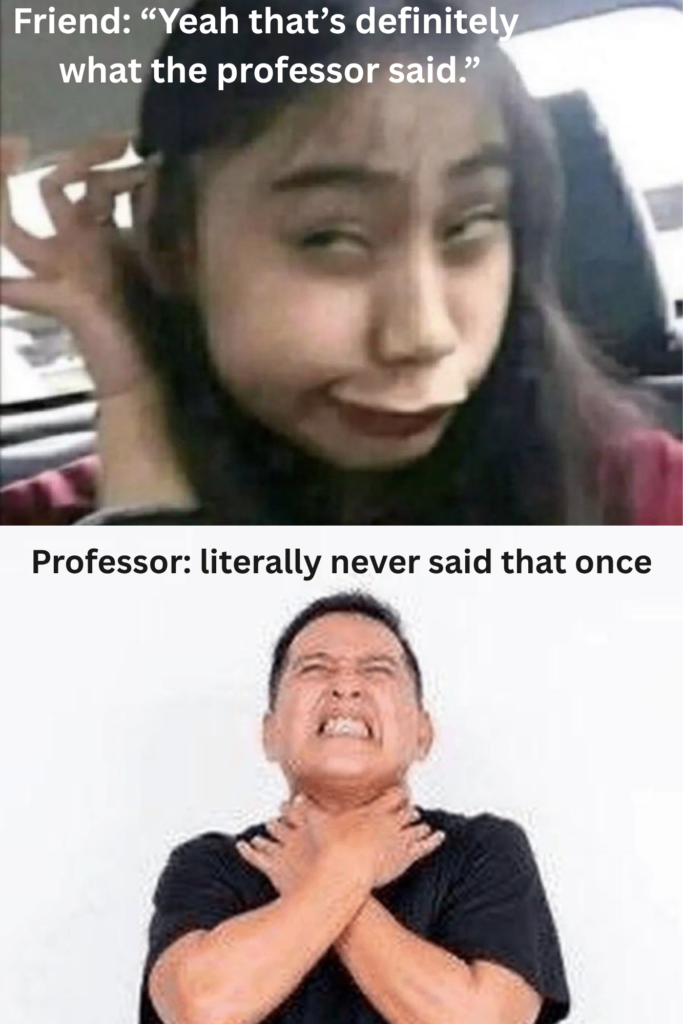
There are many situations in college where misinformation can affect your learning without you realizing it. One of the biggest ones is group studying. While it can be helpful, it can also backfire if someone explains a concept incorrectly and everyone else accepts it. I’ve personally had moments where I studied something wrong with a group and only realized it during the exam.
Another situation is reviewing your notes. If your notes are incomplete, your brain will naturally try to fill in the gaps, but it does not always do this accurately. This connects to what cognitive psychology calls reconstructive memory, where your brain fills in missing details based on what “makes sense.”
Even practice questions can influence your memory. If a question is worded in a leading way, it can push you toward remembering something incorrectly. Research by Loftus and Palmer (1974) shows that wording alone can reshape memory, which applies directly to how students interpret exam questions (1).
Memory and Reconstruction
Your memory does not work like a recording device that plays back events exactly as they happened. Instead, memory is reconstructive, meaning that every time you recall something, your brain rebuilds it using the original information along with new information and your expectations.
This is actually useful because it allows you to make connections and understand meaning, but it also makes your memory vulnerable to change. According to research discussed in Goldstein’s Cognitive Psychology, this reconstructive process is exactly what allows misinformation to become integrated into memory over time (3).
So when you feel confident about something, that confidence is not always based on accuracy; it is based on how smoothly your brain reconstructed the memory.

How to Outsmart Memory Errors
The good news is that you can actually use what we know about memory to study more effectively and avoid misinformation.
One of the best strategies is testing yourself early and often. Research shows that retrieval practice strengthens memory and makes it more resistant to being changed later (4). Instead of just rereading notes, try to recall information from memory without looking.
It is also important to check multiple sources. If you only rely on one explanation, especially from a peer, you increase your chances of learning something incorrectly. Comparing lecture notes, textbooks, and practice materials helps confirm accuracy.
Being cautious during group study is another key strategy. Instead of assuming everything is correct, ask questions like, “Where did that come from?” This forces you to think about the source and reduces source monitoring errors (2).
Writing information in your own words is also powerful because it helps you process meaning more deeply. Research on deeper processing shows that the more meaningfully you engage with information, the better you remember it (5).
Finally, don’t rely on confidence alone. Just because something feels right does not mean it is right. Double-checking your understanding can save you from avoidable mistakes.
Conclusion
All in all, understanding the misinformation effect is extremely useful for college students, especially in your first year when you are still figuring out how to study effectively. Your memory is not a perfect recording; it is something that can be influenced, reshaped, and even slightly rewritten over time.
Because of this, it is important to be aware of misleading information, pay attention to where your knowledge comes from, and actively check and reinforce what you learn. I wish I had understood this earlier, because it would have saved me from confidently studying the wrong material more than once.
It is easy to assume that if you remember something clearly, it must be correct, but cognitive psychology shows that this is not always the case. By understanding how memory works, you can take more control over your learning and avoid being misled by your own mind.
References (Footnotes)
- Goldstein, E. B. (2019). Cognitive psychology: Connecting mind, research, and everyday experience (5th ed.). Cengage Learning.
- Loftus, E. F., & Palmer, J. C. (1974). Reconstruction of automobile destruction: An example of the interaction between language and memory. Journal of Verbal Learning and Verbal Behavior, 13(5), 585–589.
- Johnson, M. K., Hashtroudi, S., & Lindsay, D. S. (1993). Source monitoring. Psychological Bulletin, 114(1), 3–28.
- Loftus, E. F. (2005). Planting misinformation in the human mind: A 30-year investigation of the malleability of memory. Learning & Memory, 12(4), 361–366.
- Roediger, H. L., & Karpicke, J. D. (2006). Test-enhanced learning: Taking memory tests improves long-term retention. Psychological Science, 17(3), 249–255.
- Craik, F. I. M., & Lockhart, R. S. (1972). Levels of processing: A framework for memory research. Journal of Verbal Learning and Verbal Behavior, 11(6), 671–684.
I think you explain memory in a relatable way. I personally HATE studying in groups, not necessarily just because I think the information they give me is wrong, but because I think it is also ineffective. The misinformation effect shows how easily someone’s confidence or our confidence in someone can trick our mind into believing a memory or fact is correct even though it is completely wrong or has been changed over time. Reconstructive memory to study is retrieval and recall even though people think it is like replaying the information video in their mind. I find it really weird to think about what having photographic memory would be like and how that would change your mind’s retrieval. I agree that testing yourself is helpful with studying rather than just going over the same info over and over. With people struggling to remember and recall information because of the use of social media and all of the short form content, how do you think retrieval is affected when all of the random misinformation and high stimulation/dopamine videos are filling our memories?