
By: Cole Smith

When I was in High School, I found myself studying for tests the night before and cramming all the material into one night study sessions. Once I got into college, I realized my prior study habits would not get me far , given how challenging the courses can be. Little did I know that the key to studying was actually something I had been doing since I was 6 years old! When you were a kid, did the story of your parents making you memorize their phone number or a street address by learning each part sound familiar? If it does, well then, you are already familiar with the concept of chunking! Splitting up the numbers in your parents’ phone number and memorizing each section, or by splitting up your street address and memorizing the number, street, and zip code separately, and then putting it all together, is a prime example of how chunking information works (1)!
What is Chunking and Its Relation to Short Term Memory
Your brain and its short-term memory can only hold so much information in it at once. Chunking greatly benefits how much storage (or memory) you can fit in your short-term memory. Some people call it a type of data compression by being able to squeeze down a lot of words into a short bank known as your short-term memory (2). When you first encounter a phrase, you might try to make each word in that phrase its own chunk, but as you familiarize yourself with that phrase, you can start making that whole phrase one chunk rather than 4 separate chunks (3). The limitations are not just phrases, though! You can do this with practically anything if you learn a good chunking method that can help you familiarize yourself with the information in your brain. Chunking is a sure-fire way to help improve your short-term memory and be able to store more information in that short-term memory bank.
How To Chunk
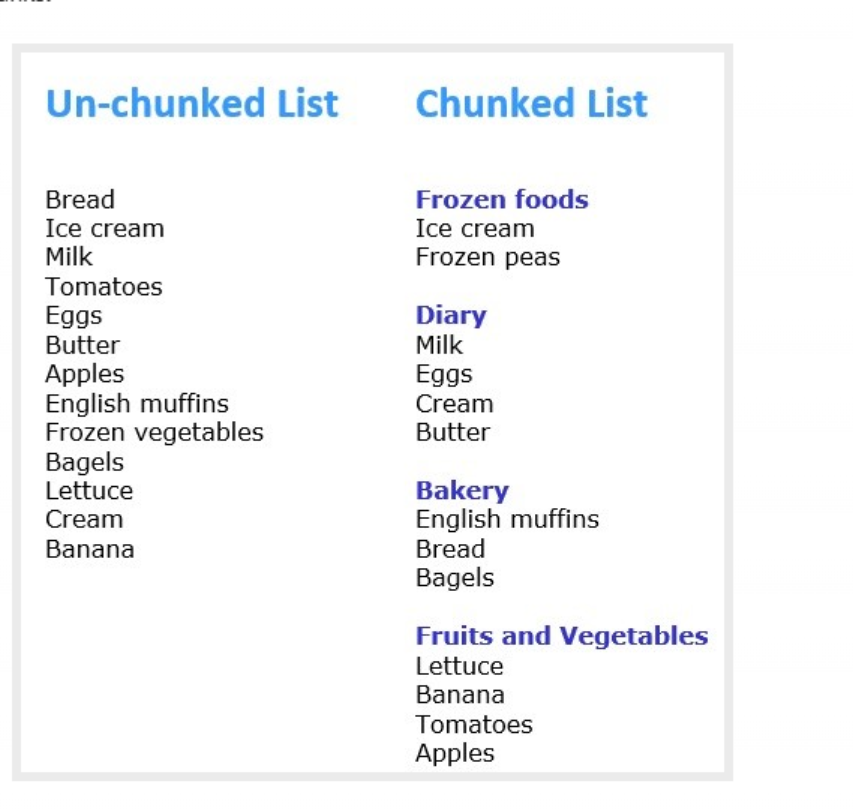
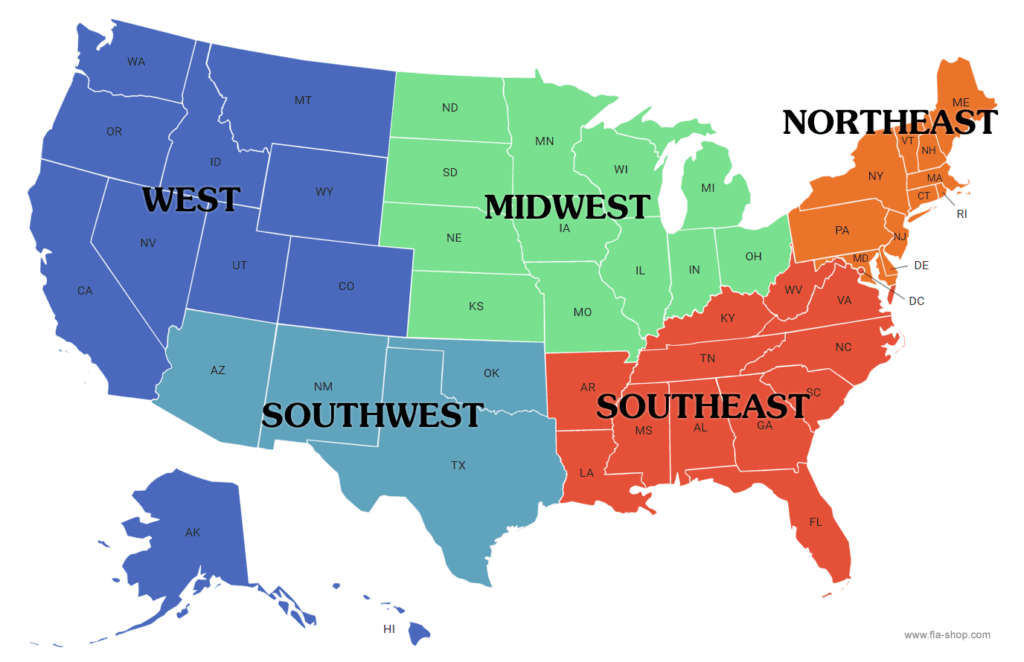
Chunking is very simple, and there’s a high chance that you already do it in your everyday life! As I mentioned earlier, having to memorize a phone number is an example of chunking, as you are chunking 3-4 different numbers in their own category. Another example is when making a grocery list. Rather than trying to memorize every single item, you might chunk an item to its category so it’s more organized and easier to remember, rather than trying to remember a super long list of groceries. Now, how can this be used in school? Well, let’s say you need to memorize the 50 states in the US. Well, rather than having to try to memorize each state, you can memorize each region. Rather than memorizing 50 states, you are now only memorizing 10-12 states. By chunking each state into a region, you are now really only memorizing 5 regions rather than 50 states. Well, that just made everything way simpler!
Why We Chunk
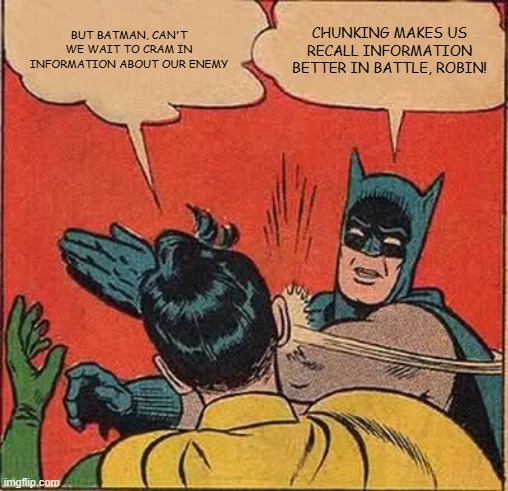
For example, you might be asking what the point of chunking is. How’s it different from trying to cram everything in your mind and remembering it for later? Well, the short answer is… Recall! Across four different experiments, it was found that not only does chunking result in better recall for information, but it also helps you recall information you didn’t chunk as well because chunked information takes up less room in your short-term memory (4)! Chunking provides a way for the short-term memory to be able to hold information, but to be able to recall it when needed. So if you are taking a stressful test, if you crammed the information in, there’s a high chance you will forget it during the test, but by studying with chunking, there’s a much higher chance you will be able to recall it when necessary.
Don’t Let Anything Interfere with Chunking!
While chunking helps benefit study habits to better retain information about a topic, there are a couple of problems or “interferences” that can arise. The first problem is proactive interference, where memory from old information can interfere with memory of new information (5). For example, when making that grocery list, there’s a chance you accidentally chunk ice cream into the dairy category, but you just got ice cream recently, and you don’t actually need it. This is proactive interference, mixing up your previous grocery list with your current grocery list, or better understood as old information mixing up your new information. The other problem that could affect your short-term memory is retroactive interference, which is where new information can interfere with older information. If you are studying for two tests, then the test that you were studying for more recently will interfere with the information you studied for in the test you studied for less recently. Both these kinds of interference can potentially affect chunking strategies, but this can also be true for every study technique.
Conclusion
Many people become stressed by college strictly because it is programmed in their mind how “difficult” the assignments and tests can be. Sure, the difficulty of assessments may increase, but by adapting the proper study techniques like chunking, it will provide a new light to how you study and provide better ways to recall information (4) and be able to squeeze more information into your short-term memory (2). By being able to chunk information, you are putting yourself in a position to succeed in college and beyond!
References
- Norris, D., Kalm, K., & Hall, J. (2020). Chunking and redintegration in verbal short-term memory. Journal of Experimental Psychology: Learning, Memory, and Cognition, 46(5), 872–893. https://doi.org/10.1037/xlm0000762
- Norris, D., & Kalm, K. (2021). Chunking and data compression in verbal short-term memory. Cognition, 208(104534), 104534. https://doi.org/10.1016/j.cognition.2020.104534
- Jones, G. (2012). Why Chunking Should be Considered as an Explanation for Developmental Change before Short-Term Memory Capacity and Processing Speed. Frontiers in Psychology, 3(1). https://doi.org/10.3389/fpsyg.2012.00167
- Thalmann, M., Souza, A. S., & Oberauer, K. (2019). How Does Chunking Help Working memory? Journal of Experimental Psychology. Learning, Memory, and Cognition, 45(1), 37–55. https://doi.org/10.1037/xlm0000578
- Atkins, A. S., Berman, M. G., Reuter-Lorenz, P. A., Lewis, R. L., & Jonides, J. (2011). Resolving semantic and proactive interference in memory over the short-term. Memory & Cognition, 39(5), 806–817. https://doi.org/10.3758/s13421-011-0072-5