The Biggest Question for College Students: How do I Study?

By Nataly Rodriguez

As an incoming freshman studying is the one skill, I hoped you learned in high school but if not here is an idea of how to study!

               Use the recency effect! Now you may be wondering what exactly that is but let me explain slowly. The recency effect is the tendency to remember most recently presented items (1). Now an example of this is if you are trying to remember a list of items it is most likely you remember the items you last studied (1). Now using this effect can help move items in short- term memory to a longer-term memory. You would have to constantly revisit the items the same way you learned them.

Continue reading “The Biggest Question for College Students: How do I Study?”

One at a Time: The Hidden Power of Singular Focus

By Gabrielle Penberthy

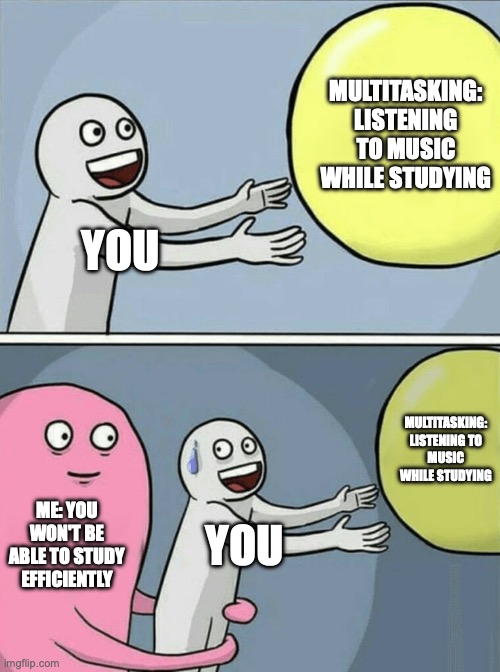
Running Away Balloon Meme | MULTITASKING: LISTENING TO MUSIC WHILE STUDYING; YOU; MULTITASKING: LISTENING TO MUSIC WHILE STUDYING; ME: YOU WON'T BE ABLE TO STUDY EFFICIENTLY; YOU | image tagged in memes,running away balloon | made w/ Imgflip meme maker

While studying, everyone has experienced the need to snap back others, listen to music, and browse Instagram. We laugh when we communicate with others, we groove to music, and we stay connected when we browse Instagram. We run the risk of drifting from our study goals when we engage in these activities while studying. It is all fun and games until we get a bad grade on that important test or the homework assignment that is half of the final grade. I understand how difficult it might be to resist temptation when your phone is so close. I find myself picking up my phone to put on music or snap others back. But when I do this, I find that I start singing along to the music, which diverts my attention from my studies. Why is this a task so hard to complete? Divided attention, or multitasking, is the term used to describe this. When this occurs, I typically end up with a low grade or find it difficult to respond to an important quiz question. This causes an excessive amount of worry and self-doubt.  

Continue reading “One at a Time: The Hidden Power of Singular Focus”

Studying is a Waste of Time: There’s a Better Way to Get the Grade You Want

By Brody Forsythe

The transformation of becoming a college freshman from a high school senior is a different transition for everyone. Depending on the individual’s experience, goals and interests, it can either be a seamless transition or one with many holes and lots of exposed seams. When it comes to academics, it can be an extremely difficult transition if one is trying to incorporate old study habits that were previously effective in high school. There are numerous students out there that will tell you about their humbling experience with their very first college exam, and I can include myself in that category. I can remember studying for my first chemistry exam thinking about how easy it was going to be to get an “A” on it, and when it came down to taking the test, not a single concept could be retrieved from my mind to help me pass the test. All I could remember was how confident I felt looking over the notes I previously written down, and looking at the practice problems we did in class months prior to the exam and thinking, “Yeah, I’ve got this!”. I was just following my old high school studying procedure and little did I know my whole world about studying was in for a rude awakening.

Continue reading “Studying is a Waste of Time: There’s a Better Way to Get the Grade You Want”

Unlock the Secret Clue: Narrative Rehearsal Hypothesis

By Makayla Behm

Starting College

Starting college is extremely hard. There are many things that you have to worry about but most importantly how to study and learn the information effectively. When starting out in college there are so many things that you have to worry about but learning how to rehearse the information you are getting should not be on one of your worry lists. 

Continue reading “Unlock the Secret Clue: Narrative Rehearsal Hypothesis”

Memory Consolidation, a Helpful Study Tool

By Frannie Heckman

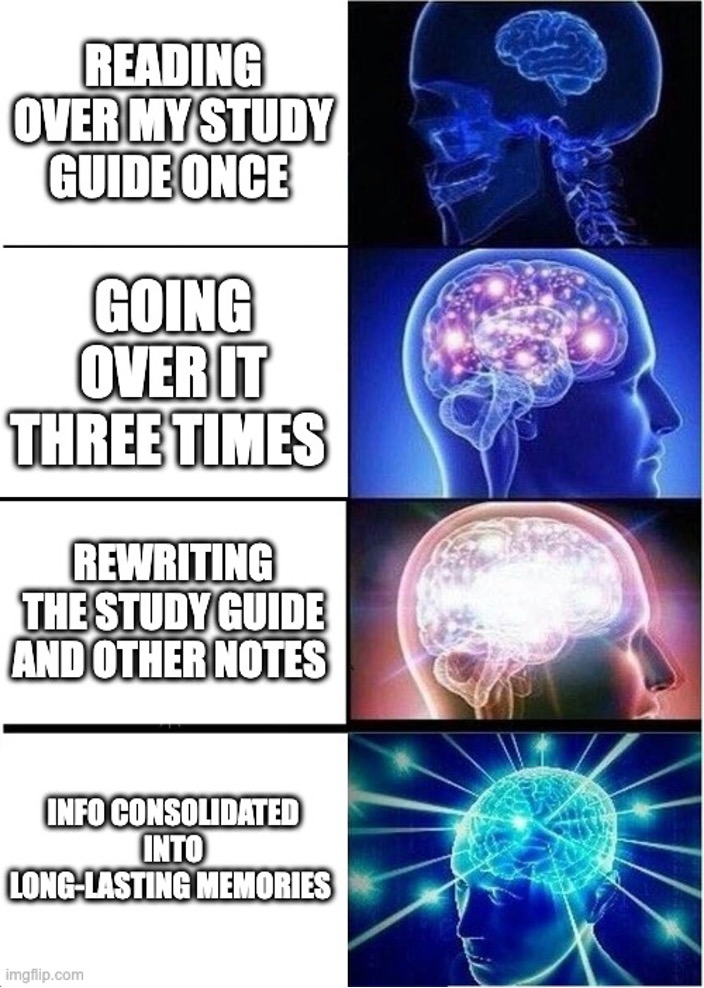
Memories are a huge factor in learning, studying, and just your everyday life as student. Learning the processes of memories and how certain memories become short-term and some become long-term, where they are in your brain, and learning how sleep can affect you, can actually be a benefit for studying and your future GPA. While studying many students just take in as much information as possible in a short amount of time this is not always the best method. Consolidation process of memories is transforming them into a more stable, longer- lasting form. (1) This can also be helpful to students to get the information they need while having it last longer in the process.

Continue reading “Memory Consolidation, a Helpful Study Tool”

Survival of the Studious: How Adaptive Behaviors Can Improve Your Learning

By Daizjah Shannon

Active learning techniques like summarizing, note-taking, and quizzing help you engage with the material and remember it better. These techniques are adaptive because they help you retain important information for future use. Active learning techniques can be used in a variety of ways to help improve your learning and retention of information, such as.

Continue reading “Survival of the Studious: How Adaptive Behaviors Can Improve Your Learning”

Interleaving: Improving Memory and Recall

By Hunter Hall

Learning and retaining information for many people within today’s school system is a struggle. Information can become skewed, easy to forget, mixed around and confused with other topics learned along with the information you’re trying to retain. There are many techniques or tips and tricks one can use to become more efficient in storing information in their mind and keeping it there. One of these techniques is interleaving. Interleaving is a technique used for retaining information at a higher rate in both short term and long term memory. The process of interleaving involves mixing around questions or terms from different topics while studying or learning new material. However, there is an argument against the effectiveness of interleaving. As Doug Rohrer, a professor of psychology at the University of South Florida, states in his article about interleaving, the argument is that some believe it can lead to an individual confusing certain information with one another (1). The example given was the words “illusion” and “allusion” (1). Despite this, research held on interleaving has shown that it does indeed improve recall. 

Buff Doge vs. Cheems Meme |  Students Who Use The; Students Who Use The; Interleave Method; Block Method | image tagged in memes,buff doge vs cheems | made w/ Imgflip meme maker
Continue reading “Interleaving: Improving Memory and Recall”

To Cram, or Not to Cram

By Jenna Kinney

Have you ever found yourself the night before a huge exam cramming in hours of studying when you could have started days ago? Or have you spread your studying out when preparing for a huge exam? I would guess that most people would agree with the first question even myself would agree with ending up in that situation before a huge exam. But which method is more effective to receive the greatest outcome from the exam that you are preparing for? First is to know these are both cognitive processes the first one being massed practice and the second one being distributed practice. Distributed practice is establishing a time to practice and engage with the material you are studying, and you do this over many different times not just once. Massed practice is when the material you are studying is done repeatedly within a short period of time, and is only done once (6). Now the big question is which one is better?

Continue reading “To Cram, or Not to Cram”

Don’t trust your brain, trust the text!

By Holly Martin

Have you ever procrastinated with studying the night before an exam thinking you understood what was going to be on it but once you get your exam score it’s lower than you were anticipating it to be? Almost all of us have been in a similar position where we either do not feel the need to study in general since we understand the curriculum that we have learned in class or do not feel the need to look over our notes, textbooks, or other resources. Though most of the time the answer that you were one hundred percent accurate on and you thought you knew so well happens to be incorrect. This concept of getting that wrong answer on your exam when you just had the intuition of getting it right is known as the misinformation effect. The Misinformation Effect is the tendency for information received after an event to interfere with one’s memory of the original happenings  (1). There are many conflicts within the misinformation effect that may have got our minds to have a correct approach to certain circumstances within what we thought we knew within our studying but substantially it does not always happen to be the plan or the outcome we were hoping to get.

Continue reading “Don’t trust your brain, trust the text!”

The Imagination of Elaboration

By Katelynn Tripp

When in the process of studying, it may feel common for you to try different strategies for obtaining the information. When we use our current knowledge and try to connect the dots on certain topics, this can be seen as elaboration. Elaboration is a core technique when learning new information because it allows us to retract previous learned knowledge, and use it to our advantage when trying to learn new information. This technique can be used in any subject, as we all have some knowledge on random things in this life. Without the skill of elaboration, I feel people would struggle with learning information. Even though this technique doesn’t determine our capabilities of learning, it does improve the likelihood of us obtaining that information. In this report, I will be explaining what the meaning of elaboration is, and some of the key techniques that go into this topic as well. 

Continue reading “The Imagination of Elaboration”