If you’re a college freshman, I hate to break it to you but college level courses aren’t as easy as high-school classes.
Your high-school teachers spent weeks slowly covering basic concepts, making surface level information easy to learn
But college is different…
Professors break down complex topics at a fast pace, while expecting you to learn more in less time…
And from my experience as a college senior, most freshmen use inefficient study tactics that prevent them from gaining a deep understanding of class material.
If you spend hours upon hours rereading the same notes and highlighting texts, while your grades suffer…
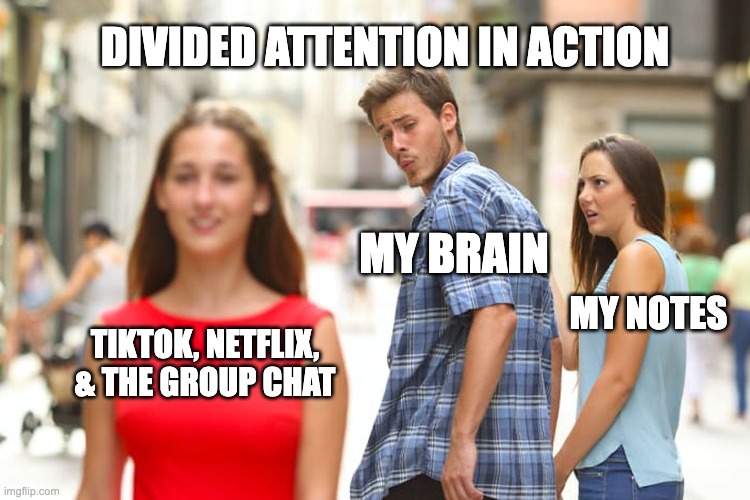
Imagine, you’re getting prepared to study for your next exam. You have your textbook open, your notes are ready, but you’re watching a TikTok on your phone. Or maybe you have a Netflix show on in the background for some “background noise”. Does this scenario sound a little familiar?
It may feel like you’re being productive because you’re multitasking multiple things at the same time, but in reality, cognitive psychology says otherwise. You’re not actually multitasking; you’re performing something called divided attention and it might be the reason why your study sessions aren’t as useful as you expected them to be. Don’t worry though, in this post I will discuss what you can do to balance your study and TikTok time.
What is Divided Attention?
Divided attention occurs when you try to focus on more than one task at a time. It splits all your mental energy between multiple tasks, unlike focused attention, where all your mental energy goes to one task. Your brain isn’t designed to completely process multiple tasks at once. Instead, it switches between the tasks, resulting in something called the switching cost. The switching cost is when you lose time, make more errors, and overall remember less information [1]. Research shows that even small distractions, like your phone buzzing or music playing in the background, can affect how you store information in your memory [2]. This is true when it comes to studying, because the more divided your attention is, the harder it is to understand and remember the information you’re learning. So next time you think that multitasking will save time, remember that it’s most likely the opposite.
For first-year college students, the transition from high school to college can be challenging, especially when the ways of studying and learning begin to change. Luckily, there are beneficial ways of improving and overcoming these challenges if we understand the concept of load theory of attention. Do not fear, it is not as complicated as it may seem, and will change the way you think about studying!
The use of Dual Coding in essence is using imagery and labeling it with a word which in turn helps you remember the word or the image one sees for the first time, and it should turn into a long-term memory. But how can we use dual coding in our freshman year in college, well depending where you go you may end up taking a class of learning a new language for extracurricular, something fun you may have a trip in mind to go to and you want to learn the language before you head out to that specific country in case the locals or the signs don’t have the language you speak. Would be awful if you get stranded in a country without knowing the language, and what would you do if your phone dies google translate won’t be translating nothing if you can’t speak at least a broken version of the country’s native language. But how does this correlate with learning a language in class or even on your own time.
Hey, there! If you’re reading this, then you are probably a first-year college student overwhelmed during syllabus week and thinking: “There is no chance I survive freshman year.” You’re thinking back to high school and reminiscing on how easy your classes were and how you spent nights before tests (when they were still called tests, and not “exams,” which is somehow much more intimidating), which you spent playing Fortnite, not cramming a semester’s worth of content in preparation for a final. Your high school teachers, parents, freshman orientation leader, and probably your TikTok “For You Page” have all most likely thrown a lot of studying hacks and advice at you, but you may still feel unprepared for the courseload you’re taking on, and unsure of how you’re going to balance 16 credit hours, Greek life, homesickness, and a social life. Do not fear! Here is a quick and simple guide on how to understand use the psychological concept of encoding to get the most out of your studying. Happy reading! Good luck with your freshman year!
When people first get to college, most kids do not know how to study. Some kids come into college homeschooled, some did not go to a public school while others went to a school where they did not have to study for hard tests/exams. Incoming freshmen wanting to go to college are blindsided when it comes to how much studying really affects how well someone does in college. Coming to college has made me realize how much studying you have to do. Knowing how to study the right way is something that has helped tremendously while being in college. College is a scary thing but knowing how to study the right way and pass your classes will make college so much easier in the future.
The Spacing Effect and how it works
Just hearing the word Spacing effect when it comes to studying may scare some students off and they will probably look past it like it is nothing, but it is very important. The Spacing Effect, when it comes to studying, is one of the earliest discoveries in human learning (1). It is proven that if a student spaces out their studying and processes what they are learning, they will remember and learn the information and memorize it better (1). For example, if you have a big exam coming up, it is better for you to take breaks throughout the time you are studying to help understand the information more.
A lot of kids will struggle with studying when they first start college. Some kids may have gotten by with their study habits in high school but most of the time, these study habits don’t quite help anyone in college. College is so much different in that there aren’t many small assignments that help you to make sure you understand the material like there were in high school. There are lectures, quizzes, participation, papers, presentations, and exams and that’s pretty much it when it comes to grades in college. For me, I tried to take on high school by myself whenever I could but that will not go will with you for college. I highly encourage any freshmen coming in to immediately start going to some study groups or just collaborating with at least one person that you can count on.
Are you cramming for exams? Do you drown in flashcards? There’s a science-backed lifeline that could change the way you hit the books. It’s called maintenance rehearsal, not your average study hack. It’s a brain-tuning, memory-maxing method that could turn your study woes into wins.
Have you ever sat down to do homework, study, or to focus on a topic and realized that it is difficult to ignore distractions around you? Have you ever wondered why it is so difficult to filter out distractions, even though you desire to be productive? At several points in a student’s academic career, most people often struggle with truly remaining focused while doing schoolwork and other important tasks. There can be many aspects of why a student cannot stay focused, especially if they are preoccupied with other events in their life.
What is Selective Attention?
One main reason that students can become so easily distracted is that selective attention is an obstacle that every student faces. Selective Attention is the process of having an ability to focus on a particular subject in their direct environment for a specific amount of time. For a student to be truly productive with their work, they must put in effort with this process and actively ignore all other distractions around their working environment. For this process to be a success, a person must be selective in their own attention and realize what they must drown out in the background. For a lot of young people, it can be a challenging task to drown out distractions such as their phones or other technology that is not helpful to be used in the moment.
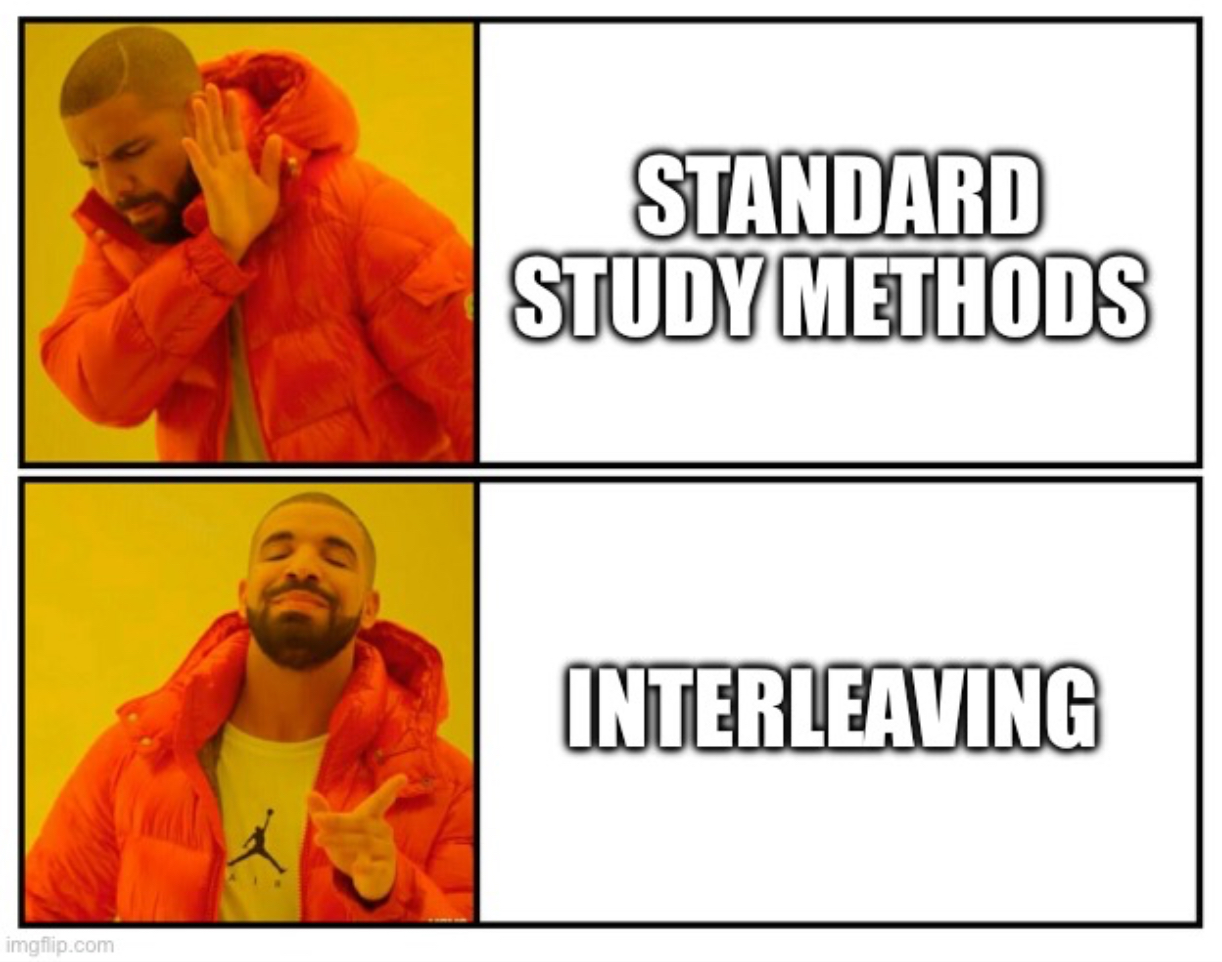
Entering college can be stressful, overwhelming, and confusing. Often you are bombarded with so much information in so little time. You may be told by different professors about various study tips like making flashcards, using Quizlet, highlighting main points, and much more. What if I told you there is a compressed and more effective way to learn? You could use interleaving.
ID used to identify users for 24 hours after last activity
24 hours
_gat
Used to monitor number of Google Analytics server requests when using Google Tag Manager
1 minute
__utmx
Used to determine whether a user is included in an A / B or Multivariate test.
18 months
_ga
ID used to identify users
2 years
_gali
Used by Google Analytics to determine which links on a page are being clicked
30 seconds
__utmb
Used to distinguish new sessions and visits. This cookie is set when the GA.js javascript library is loaded and there is no existing __utmb cookie. The cookie is updated every time data is sent to the Google Analytics server.
30 minutes after last activity
__utmc
Used only with old Urchin versions of Google Analytics and not with GA.js. Was used to distinguish between new sessions and visits at the end of a session.
End of session (browser)
__utmz
Contains information about the traffic source or campaign that directed user to the website. The cookie is set when the GA.js javascript is loaded and updated when data is sent to the Google Anaytics server
6 months after last activity
__utmv
Contains custom information set by the web developer via the _setCustomVar method in Google Analytics. This cookie is updated every time new data is sent to the Google Analytics server.
2 years after last activity
_gac_
Contains information related to marketing campaigns of the user. These are shared with Google AdWords / Google Ads when the Google Ads and Google Analytics accounts are linked together.
90 days
__utma
ID used to identify users and sessions
2 years after last activity
__utmt
Used to monitor number of Google Analytics server requests