
By: Kayleigh Zerrusen
Introduction
If you were to ask me to travel back to my first semester of college, I would give myself the advice to find a better way to study instead of just looking over notes that I copied and pasted from class. Most students will find themselves spending hours on end looking over notes and reading through textbooks. This tends to lead them to feel unprepared during exams and tests. Students think that this is caused from a lack of effort, but it could be the way your brain is processing information. An important idea from cognitive psychology that explains this issue is top-down processing. This process shows how knowledge that you have been taught previously and other experiences shape the way we comprehend and understand new information. Although top-down processing can be useful, there is also a possibility it can lead to misunderstanding when we study if it is not used the correct way.

What Top-Down Processing Is
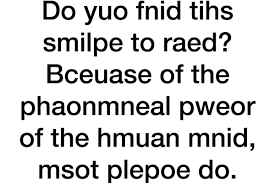
Top-down processing is the action that the brain uses what you already know to benefit you to understand new information that is being taught to you. Instead of taking in every little detail when you are first taught a new detail, your brain will fill in the missing pieces based on your past experiences and what you already know. For example, if you read a sentence with missing letters or misspelled words, you can quite easily still figure out the purpose behind the sentence because your brain automatically predicts what the words are supposed to be. This idea proves that perception is not just about what is actually in front of you, it is also shaped by what you expect to see. In cognitive psychology, researchers have explained that our brains are constantly making predictions about the world and how we see it. When you are studying, that means you are not just reading words from a textbook, but instead you are actively interpreting them through what you already know. We should be interpreting it through what we already can piece together with past information. Sometimes this situation helps us learn faster because we can connect new information to old ideas. Other times, this can lead us in the wrong direction.
Negative Effects of Studying
The problem with top-down processing is that it can sometimes mess with your learning. Students may misinterpret what the real message is behind certain ideas because they were misled by the information. This can also make people skip over important details due to the fact they assume they already understand the ideas. Another issue would be overconfidence. Some people think that if something feels familiar, you think you understand it. This happens especially when trying to explain answers on tests and homework. Studies on memory and perception show that our expectations are heavily influenced by what we notice and remember. This accident tends to lead to mistakes without us even realizing what has happened. As a result of this, people might skip over important information since they assume they already know the main ideas. This can also lead to overconfidence in certain subjects. This is when something feels so familiar that it creates illusions that we understand it better than what we actually do. This mostly is commont when studying, such as rereading notes.
How to Use It in a Positive Way
At the same time, top-down processing is not all bad. You can actually use it to study better if you do it the correct way. For example, it helps to think about what you already know before learning something new. This gives your brain a starting point. Instead of just rereading notes like most people would think would help, it would be more efficient to test yourself by trying to reexplain the material you learned in class but in your own words. That is when you really find out what you do and do not know yet. It can also make you have more of a drive to pay attention during class that way you can remember little details when you are going over the information later. This will help you point out ideas that do not match up with your expectations instead of just brushing past it. The best way to learn seems to be combining what you already know with the actual details from the textbook and notes.
Conclusion
In the end, top-down processing is a big part of how we learn, whether we notice it or not. It helps us to understand things faster and also humble us by letting us know that we do not know as much as what we would like to think we do. That is why studying just by rereading it is not enough. You have to be able to actually test yourself and make sure you understand the material, not just notice it. Once you come to the realization of how much your brain fills in on its own, it makes you a lot more careful about how you study and the information you study.
- Gregory, R. L. (1970). The intelligent eye. Weidenfeld & Nicolson. https://archive.org/details/intelligenteye0000greg
- Gilbert, C. D., & Li, W. (2013). Top-down influences on visual processing. Nature Reviews Neuroscience, 14(5), 350–363. https://doi.org/10.1038/nrn3470 (if required by your instructor; otherwise sometimes optional depending on access rules) https://pubmed.ncbi.nlm.nih.gov/23595013/
- Kersten, D., Mamassian, P., & Yuille, A. (2004). Object perception as Bayesian inference. Annual Review of Psychology, 55, 271–304. https://doi.org/10.1146/annurev.psych.55.090902.142005 https://pubmed.ncbi.nlm.nih.gov/14744217/
- Goldstein, E. B. (2018). Cognitive psychology: Connecting mind, research, and everyday experience. Cengage Learning. https://archive.org/details/cognitivepsychol0000gold_a9a4
- Stroop, J. R. (1935). Studies of interference in serial verbal reactions. Journal of Experimental Psychology, 18, 643–662. https://doi.org/10.1037/h0054651 https://psych.hanover.edu/classes/Cognition/Archive/2009/Papers/stroop%201933.pdf