The start of your college career! You made it a step further in your educational journey and now begins the real fun. You have most likely faced a number of problems that you have needed to solve along the way. Spoiler alert: You are going to face more! While you step into this new realm, you are undoubtedly going to come across more obstacles. Don’t worry, because I’ll give you some insight (wink wink) into a great way to solve the problems you’re going to come across. This method is called Gestalt problem solving and before you think to yourself what the sigma is that, I’ll tell you. Gestalt problem solving is reorganizing or thinking about the problem in a different way so you are able to come to that “lightbulb” moment you so desperately desire (1).
Have you ever wondered why some teachers or professors will use real-world situations or concepts to explain certain topics? You could say that it’s because they aren’t great at explaining concepts in class, and had no better way to drive home a point. But in reality, they are using concrete examples to amplify your learning experience, make the lesson memorable, and fill in the gap between hard-to-grasp concepts and reality. So, what are concrete examples, really? Concrete examples are specific, real-life examples (or tasks) that help to illustrate an idea or concept (2). Concrete examples are an extremely powerful tool that will help turn abstract ideas into tangible concepts that are easier for students (or anyone) to grasp. There are multiple advantages to using concrete examples to supplement your studying and aid the learning process (5).
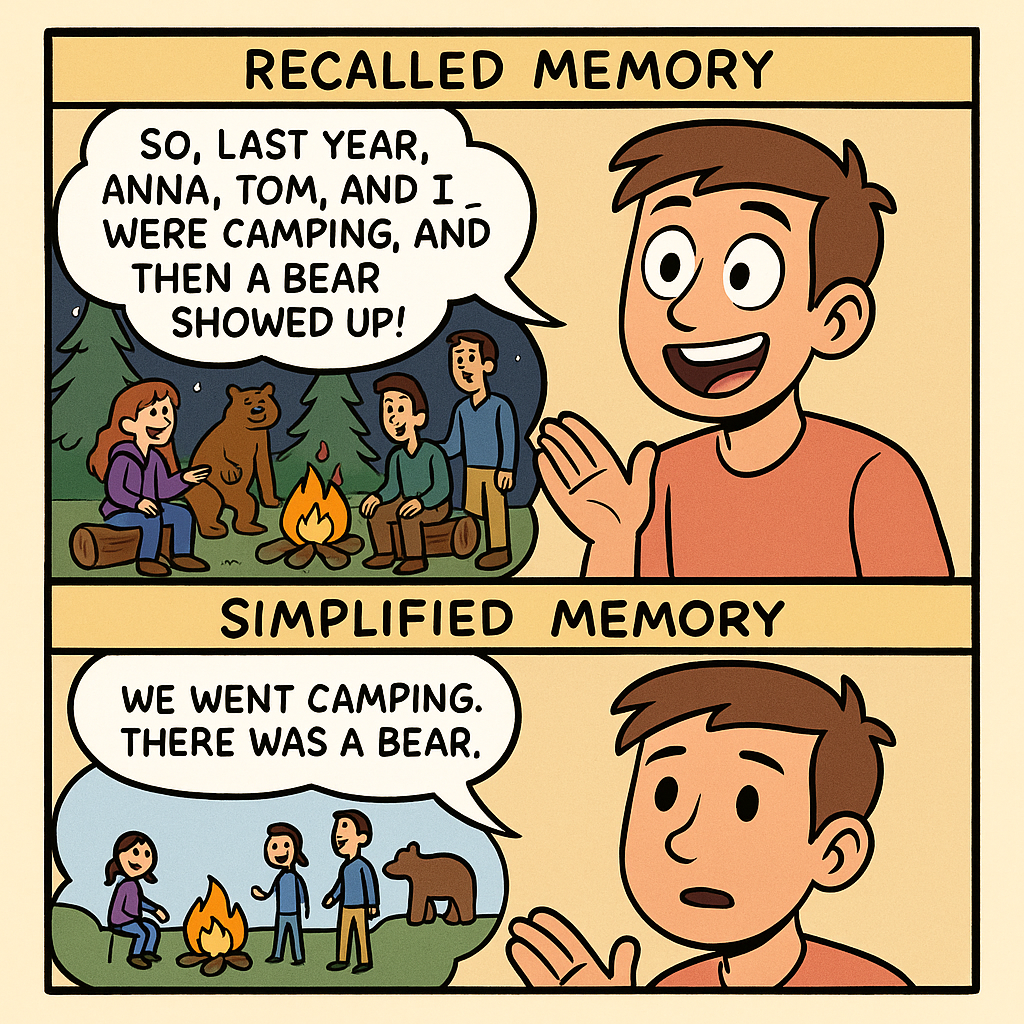
Have you ever told a story and had a fiend stop you in the middle and say ” wait, that is not what happened?” You are not the only one. Our memories are strong, yet they are also imperfect. When we remember something, we are not replaying a flawless, put in order video. Instead, we are reconstructing bits and pieces from our memory and some times we leave parts out. This is known as leveling.
Leveling is a type of memory distortion where people unconsciously leave out minor or less important details while remembering or retelling an event¹.For example, imagine your brain pressing the TL;DR (to long, don’t read) button when you try to recount a story. Let’s assume someone tells you about a wild weekend excursion where they met three individuals from various nations, tried a meal they couldn’t pronounce, and ended up traveling in a truck bed under the stars. You might relate it as: “They met a bunch of people and had some food and a crazy night.”
leveling is one of three memory distortions, the other two being sharpening and absorption. Sharpening emphasizes or exaggerates crucial aspects, while assimilation changes memories to meet our expectations, leveling is all about simplification²
When does it start?
Leveling begins in childhood. When children learn to recall and explain events, they frequently omit specifics and focus on the broad picture. This is not laziness; it is how cognitive development occurs. Our brains learn to prioritize relevance over completeness³. As we mature, this behavior becomes ingrained in how we store and access a wide range of information, from personal recollections to academic content. In fact, researchers believe leveling is a product of schema-based memory. Schemas are mental frameworks we use to understand the world. When something doesn’t fit a schema, we’re more likely to forget it or reshape it to fit our expectations⁴. In this way, leveling becomes a tool for our brain to make sense of complex, confusing life events.
My research
One of the most famous studies on memory and leveling comes from Frederic Bartlett’s 1932 experiment, The War of the Ghosts. In the study, British participants read a Native American folktale filled with unfamiliar cultural references. When asked to recall the story later, they tended to simplify it, leave out foreign elements, and change details to make it more familiar⁵.
This demonstrated that memory is not a perfect recording, but rather a reconstruction. Leveling helped participants remember and recount the tale more easily, but it also generated distortions.
How to use leveling to study
When you’re studying for a huge test or trying to remember knowledge from a lecture, your brain will naturally strive to simplify it. This can be useful—you could compress a lengthy paragraph into a brief summary that is simpler to recall. However, if you level too much, you risk missing out on important information.
Assume you’re studying psychology and learning about classical conditioning. If you remember that it contains dogs and bells but overlook the fact that the unconditioned stimulus and reaction are part of the main process, your knowledge will be incomplete.
According to cognitive research, students often level material in ways that hurt comprehension, especially when dealing with unfamiliar or complex topics⁶. In fact, when students (me as well) take notes, they frequently simplify too much, leaving out essential information that would otherwise help them appreciate the big picture.
Study smarter
Here are some tips to help study better ( Ive started to use some of these myself)
Review regularly. When you go back to your notes or readings, you’ll catch any details that your brain might’ve “leveled out” earlier.
Use self-explanation. Try teaching a concept to someone else. If you find you’re oversimplifying, revisit the material.
Create concrete examples. Just like in math or history classes, using specific real-world scenarios helps you remember more than just the gist.
test yourself. Practice questions that force you to recall deeper details, not just the broad strokes.
real world example of leveling while you’re learning
imagine a law student learning about the United States Supreme Court. Reading briefs, delivering oral arguments, collaborating, and writing opinions are all part of the process. However, after a few weeks, the student recalls it simply as “The Supreme Court decides big cases.” That’s leveling: they preserved the overall notion but removed the individual steps.
While the reduced approach may aid in general knowledge, it will not suffice to answer an exam question that requires the entire process. This demonstrates why understanding levels is especially beneficial for students: you can utilize simplification to your advantage if you know what the original concept looked like.
lets end this thing
Leveling is a memory shortcut that allows us to condense complex experiences, but it can also lead to forgetting or misinterpreting the finer details. From childhood to adulthood, our brains typically remove elements to make stories simpler to remember and share. However, when it comes to studying and learning, we must realize when we are oversimplifying.
Whether you’re studying for an exam or simply trying to comprehend new material, being conscious of levels allows you to become a more strategic learner. Consider this analogy: leveling is similar to film editing. If you remove the wrong scenes, the entire story may lose its meaning.
So, the next time you respond, “I kind of remember that,” take a moment to consider what your brain may have missed.
Schacter, D. L. (1999). The seven sins of memory: Insights from psychology and cognitive neuroscience. American Psychologist, PubMed
Loftus, E. F. (2005). Planting misinformation in the human mind: A 30-year investigation of the malleability of memory. Learning & Memory,PubMed
Fivush, R., & Nelson, K. (2004). Culture and language in the emergence of autobiographical memory. Psychological Science,SAGE Journals
Alba, J. W., & Hasher, L. (1983). Is memory schematic? Psychological Bulletin
Bartlett, F. C. (1932). Remembering: A Study in Experimental and Social Psychology. Cambridge University Press. APA PsycNet
Kiewra, K. A. (1985). Investigating note-taking and review: A depth of processing alternative. Educational Psychologist,Taylor & Francis Online
Many people have said that you must go to college to get the “college experience,”
which would open you up to new opportunities and material that would help fulfill your dreams in life.
Over the years I have recognized this fantasy and replaced it with a more “real” outlook on college.
Deadlines lurking around every corner,
A new assignment posted every hour,
A forgotten project pushed to crunch time.
In short, the college experience has been extremely overwhelming and tough, but there is no reason to fear it because there are many ways in which you can drastically increase your attention ability.
We will look at a particular psychological concept in this paper, that can improve your cognition and daily functioning [1], and help you grasp the most important information for studying. This concept is known as selective attention, and it works as our brain’s built-in thought filtration system.
When you first enter college life becomes a whirlpool of lectures, assignments, quizzes, and exams. In the midst of all of that chaos you have to continuously attempt to retain large amounts of information for things such as a quiz, an essay, or an exam. Although there are many ways to go about remembering one of the techniques that can be used is Maintenance Rehearsal.
What is Maintenance rehearsal?
Maintenance rehearsal is pretty much as its name suggests. It is the process of repeatedly rehearsing information in a short-term memory without any meaningful processing or connections to existing knowledge” [1] The Atkinson and Shiffrin memory model describes it best as something that simply roams in your head till it is time to use it. An example of this includes things like remembering a phone number regardless of how bad you want to keep it in your head most likely after it’s served its purpose you won’t remember it much after [2]. This is part of the phonological loop and is seen as the first step which is taking verbal information in and keeping it in your head temporarily before it gets lost or is stored [3]. Along with that while preparing for a test normally one will repeat the information to retain it just long enough to pass the test, after that the knowledge is like it never existed.This skill is used by pretty much everyone at some point in their life but now more than ever you may find yourself needing it.
Just found out you have an exam coming up soon? Need a new way to study to keep your focus? There is a simple trick to help you instead of cramming and rereading the information for hours. It is called chunking! Chunking helps you break down course material into more manageable pieces to help you remember. We will be diving into how this works and how to help you study a lot smarter!
What is Chunking?
Chunking is a strategy where you take information and break it up into smaller pieces to help your brain remember the information.1 Chunking can help you remember things in smaller quantities instead of memorizing everything at once. Think about it when you were younger trying to remember your mom or dads phone number. You learned the phone number in chunks not all at once. Everyone uses chunking without even realizing it. Why not use it to get that good grade on your next exam.
Studying for college exams can be stressful and scary especially when you do not know what to study, or how to know what information or material you should be reviewing. Not knowing what to study or how to study can cause students to not get the best results from reviewing, or completely avoiding it altogether because it does not help. When studying do you ever think back to see if you can recall the information? Knowing what you will be able to recall is known as metamemory. Using metamemory you can estimate how well you will be able to remember something, or judge how well you will be able to bring it forward when that information is needed. Maybe sometimes you have studied, and when you are given the exam you cannot quite pull the information forward that you know is in there somewhere. This is also metamemory.
When people first get to college, most kids do not know how to study. Some kids come into college homeschooled, some did not go to a public school while others went to a school where they did not have to study for hard tests/exams. Incoming freshmen wanting to go to college are blindsided when it comes to how much studying really affects how well someone does in college. Coming to college has made me realize how much studying you have to do. Knowing how to study the right way is something that has helped tremendously while being in college. College is a scary thing but knowing how to study the right way and pass your classes will make college so much easier in the future.
The Spacing Effect and how it works
Just hearing the word Spacing effect when it comes to studying may scare some students off and they will probably look past it like it is nothing, but it is very important. The Spacing Effect, when it comes to studying, is one of the earliest discoveries in human learning (1). It is proven that if a student spaces out their studying and processes what they are learning, they will remember and learn the information and memorize it better (1). For example, if you have a big exam coming up, it is better for you to take breaks throughout the time you are studying to help understand the information more.
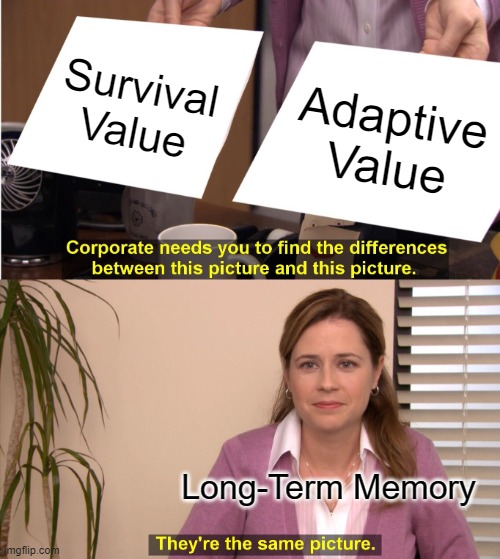
Survival value (also known as adaptive value and connection to survival processing) is understanding memory and how memory is used to survive which leads to survival processing that encodes items into our memory(1)! Survival value leads to enhanced memory by relating words to situations that others have not experienced (the apocalypse!!!) This works because when we relate words to our survival, we are linking to something meaningful that will stick in our minds(2). In cognitive psychology, survival value refers to the adaptive benefit of certain cognitive processes or behaviors that assist one’s survival.
Trying to learn new information while having to remember old information is hard, especially the thought of coming in as a first-year college student. The thought of trying to learn multiple classes and courses at once at a high level can be stressful, especially coming out of high school. The class schedule in college is confusing within itself. Trying to figure out how you will study for your psychology of learning exam on Monday and your cognitive psychology exam, also on Monday. When you go in to take your cognitive psychology exam, you completely forget everything you studied from earlier chapters, but can only remember everything from recent chapters. This is what is called retroactive interference (RI). This process occurs when learning a new task that then impairs the previously learned task (1). As you continue throughout the exam, you remember stuff from chapters from the start of the year. As you start remembering those earlier chapters, you cannot seem to remember anything from the chapters you just learned! This is what is called proactive interference (PI). This process occurs when the old task you learned impairs the ability to learn or remember the new task (1). There are some ways to stop these interferences from occurring for you little newcomers. To stop these from happening you need to fully understand which interference is which and what they fully mean. Here is a little acronym trick for you, Proactive = Old, Retroactive = New (“P.O.R.N”).
ID used to identify users for 24 hours after last activity
24 hours
_gat
Used to monitor number of Google Analytics server requests when using Google Tag Manager
1 minute
__utmx
Used to determine whether a user is included in an A / B or Multivariate test.
18 months
_ga
ID used to identify users
2 years
_gali
Used by Google Analytics to determine which links on a page are being clicked
30 seconds
__utmb
Used to distinguish new sessions and visits. This cookie is set when the GA.js javascript library is loaded and there is no existing __utmb cookie. The cookie is updated every time data is sent to the Google Analytics server.
30 minutes after last activity
__utmc
Used only with old Urchin versions of Google Analytics and not with GA.js. Was used to distinguish between new sessions and visits at the end of a session.
End of session (browser)
__utmz
Contains information about the traffic source or campaign that directed user to the website. The cookie is set when the GA.js javascript is loaded and updated when data is sent to the Google Anaytics server
6 months after last activity
__utmv
Contains custom information set by the web developer via the _setCustomVar method in Google Analytics. This cookie is updated every time new data is sent to the Google Analytics server.
2 years after last activity
_gac_
Contains information related to marketing campaigns of the user. These are shared with Google AdWords / Google Ads when the Google Ads and Google Analytics accounts are linked together.
90 days
__utma
ID used to identify users and sessions
2 years after last activity
__utmt
Used to monitor number of Google Analytics server requests