You know those days where you tell yourself you’re going to be super productive, get all your work done, and finally stay focused… and then somehow you end up doing literally anything else? Yeah, same.
You sit down, open your laptop, maybe even have a snack ready, and within minutes, you’re checking your phone and giggling at random videos you didn’t even mean to tap on. Being a first-year college student is already a big adjustment, and trying to stay focused on top of that can feel impossible.
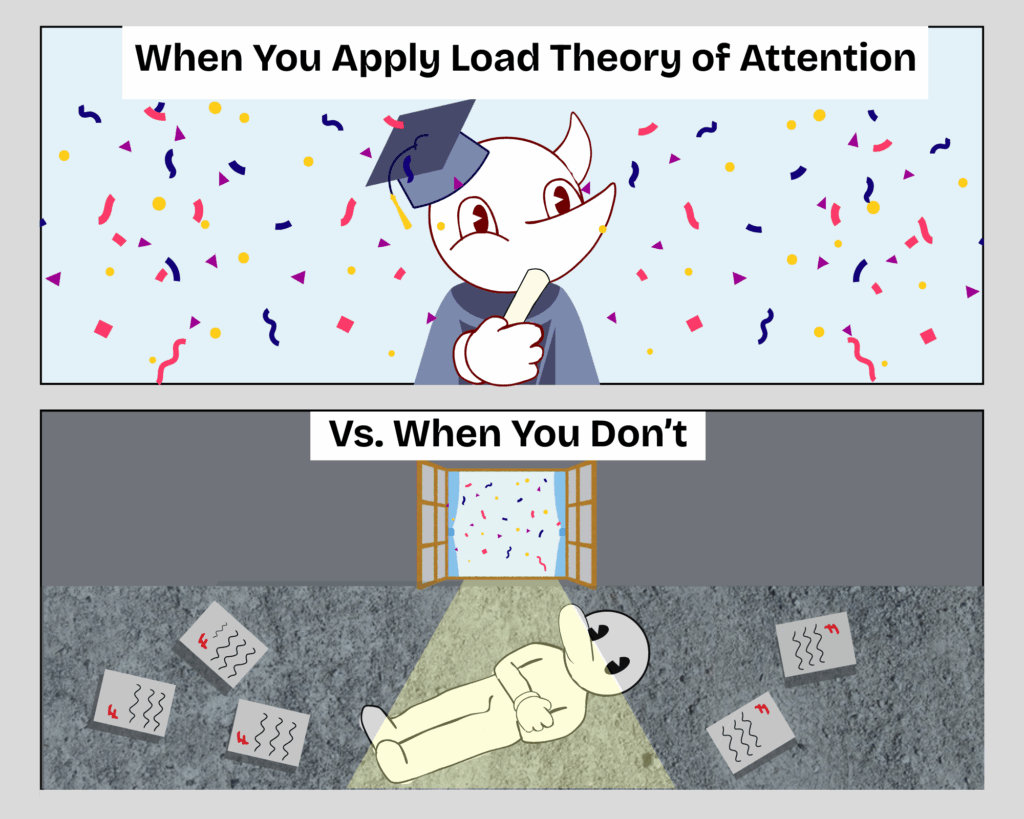
Have you ever noticed that, when you are working on a tough homework assignment, the world shuts down around you? You become hyper-focused on the task in front of you that you barely register someone coughing a few feet away from you or the sound of music playing through your headphones. However, when you pull out your phone and start watching Tik Tok, suddenly every single noise is audible. The person talking loudly across the room, the sound of someone getting out of a chair, the person coughing from early, all of it begins to distract you from your daily doom scroll. Why is that? Well, you may be experiencing something called load theory of attention, and when it comes time to study for those college exams, it may be something you want to be aware of.
For first-year college students, the transition from high school to college can be challenging, especially when the ways of studying and learning begin to change. Luckily, there are beneficial ways of improving and overcoming these challenges if we understand the concept of load theory of attention. Do not fear, it is not as complicated as it may seem, and will change the way you think about studying!
Do you often have trouble studying for exams? Does it seem like even though you put in countless hours studying that you can never remember what you need to when it comes time to sit down and actually take a test? You may be studying wrong.
THE LOAD THEORY OF ATTENTION
The load theory of attention explains how people can focus on a certain task while ignoring irrelevant stimuli. This theory includes two concepts, processing capacity and perceptual load. Processing capacity refers to the limited amount of information a person can focus on at one time. Your working memory can only handle so much at a time and still successfully carry out a task. Perceptual load refers to the amount of information a particular task involves. A high-load task, involving a large amount of information, will fill up your entire processing capacity. A low-load task, dealing with a small amount of information, will only take up a small portion of the processing capacity (1). In other words, a difficult task will require all of your attention to perform, while an easier task leaves room for distractions to take over your attention.
You feel as though everything is piling up and you’ll never get it all done. Join the club! Your not alone; there are thousands of students and employees with a mountain of responsibilities that seem too overwhelming. Not to mention the countless distractions life throws at you, especially cell phones. You wish there was some formula for completing all the tasks your assigned. Unfortunately there is not but by gaining knowledge about your ability to pay attention you can learn some tips and tricks to help you focus your attention on the things you want while ignoring the things that are distracting.
ID used to identify users for 24 hours after last activity
24 hours
_gat
Used to monitor number of Google Analytics server requests when using Google Tag Manager
1 minute
__utmx
Used to determine whether a user is included in an A / B or Multivariate test.
18 months
_ga
ID used to identify users
2 years
_gali
Used by Google Analytics to determine which links on a page are being clicked
30 seconds
__utmb
Used to distinguish new sessions and visits. This cookie is set when the GA.js javascript library is loaded and there is no existing __utmb cookie. The cookie is updated every time data is sent to the Google Analytics server.
30 minutes after last activity
__utmc
Used only with old Urchin versions of Google Analytics and not with GA.js. Was used to distinguish between new sessions and visits at the end of a session.
End of session (browser)
__utmz
Contains information about the traffic source or campaign that directed user to the website. The cookie is set when the GA.js javascript is loaded and updated when data is sent to the Google Anaytics server
6 months after last activity
__utmv
Contains custom information set by the web developer via the _setCustomVar method in Google Analytics. This cookie is updated every time new data is sent to the Google Analytics server.
2 years after last activity
_gac_
Contains information related to marketing campaigns of the user. These are shared with Google AdWords / Google Ads when the Google Ads and Google Analytics accounts are linked together.
90 days
__utma
ID used to identify users and sessions
2 years after last activity
__utmt
Used to monitor number of Google Analytics server requests



 You feel as though everything is piling up and you’ll never get it all done. Join the club! Your not alone; there are thousands of students and employees with a mountain of responsibilities that seem too overwhelming. Not to mention the countless distractions life throws at you, especially cell phones. You wish there was some formula for completing all the tasks your assigned. Unfortunately there is not but by gaining knowledge about your ability to pay attention you can learn some tips and tricks to help you focus your attention on the things you want while ignoring the things that are distracting.