Elaborate is what we constantly hear. Did you know we have a great elaborate machine in our brain that takes up what we experience and combines it? Our mind reconstructs what we experience and makes it different, but still lets us retrieve the right information for a deeper understanding of knowledge, like collage.
First, let’s dive into Elaborative Rehearsal, which uses meanings and connections to help transfer information to long-term memory. “Generating questions makes you think hard about the material and fosters comprehension (B. Wong,1995). Additionally, answering questions such as “Why is this true? Or what parts of this page are new to me? will help you to learn because it connects what you are learning to what you already know.” (Putnam et al.,2016) Looking at that quote, you can see that comprehension is done by connections and not just by memorizing information.
Think of the last test you took. Was there a question on that test that you could not remember even though you knew it was in the study guide? Was it in the middle of the study guide rather than the beginning or end? This is the Serial Position Effect. As described, the Serial Position Effect is the tendency to remember information from the beginning or the end but to forget information. While this may seem straight forward, it can actually be quite complex and effect people more often than you would think. But do not worry, we’re gonna talk about it.
It is easy to fall victim to procrastination and decide to cram a study session right before an exam. Procrastinating will only give you mediocre scores and a whole Lotta stress. Our brain can memorize information much more successfully when studying is spaced out across hours, days, or even weeks. Studying too much over a short period can lead to overstimulation of neurons and mental fatigue. If you want to get great exam scores while still being able to go out and enjoy yourself try out the spacing effect. Even if you only study for ten minutes every day for a week, you’ll have more success in memorizing the implementation than you would if you studied for two hours only once. You don’t have to give up your weekends to succeed.
Do you want information to process better and stay in your LTM (Long Term Memory)? Well, all you have to do is follow the Levels of Processing Theory. The Levels processing Theory says the depth of processing information has a big impact on how well it is remembered.
What Is Levels of Processing Theory?
Levels Processing Theory is the theory that assumes that deeper, more meaningful engagement with information leads to better memory retention compared to shallow processing that focuses on surface details. It is also the idea that the way information is encoded affects how well it is remembered. The deeper the level of processing, the easier the information is to recall. With Levels of Processing Theory, there is some Circular reasoning, in the context of levels of processing, refers to the flawed argument where the premises are used to support the conclusion, and the conclusion is also used to support the premises, creating a loop without providing independent evidence for either.
Do you struggle remembering everything discussed in the presentation throughout the lecture? You’re not alone. Let’s take a closer look, using the Narrative Rehearsal Hypothesis, at how translating your study notes into stories can aid in improving your information retention skills.
What is Narrative Rehearsal Hypothesis?
The Narrative Rehearsal Hypothesis makes it that we are able to remember events more easily when we place them into a narrative consistent with the events. This is because the story makes the events more memorable. Taking advantage of the fact that our minds naturally like to work with and memorize information that is presented in story format, this technique takes advantage of our natural instincts. You will need to translate your study material into a narrative. You’d rather concentrate on identifying the central ideas or themes that are contained in the material you are reading and not on memorizing certain facts. This will enable you to comprehend the material better.
Build a Narrative:
1.Apply new information to a story that you are currently telling.
2.If the story you are telling is more imaginative and stimulating, your memory will be better at remembering the information you are telling.
3.Incorporating the feelings is important simply because our brains can remember things that have emotions behind them better. Trying to include feelings in your tale is something that you should attempt to do if you wish it to be remembered better.
4. Rehearsing the story, as it helps to make your memories and your brain become more strongly linked, remembering the story and telling it to yourself a few times is an effective way of strengthening these links.
If you also wish to explain the ideas to another individual, you can tape yourself and listen back later.
Examples from Out in the Real World
Studying the American Revolution? Instead of memorizing dates and names, you can spend time building a story that is centered around important people and events. Imagine, for example, that George Washington is a stubborn hero who is faced with challenges, and that each one of those challenges is a turning point along his journey to independence.
The Current Evidence Served by Science
It has been demonstrated through the application of research that narrative rehearsal is a powerful means of improving memory. The outcome of a study carried out by Gagnon and Dixon (2008) discovered that the implementation of collaborative storytelling resulted in improvement in the ability of the participants’ to recall information.
The More General Advantages Outside of the Examinations
The goal of the Narrative Rehearsal Hypothesis is not limited to just enhancing your performance on tests. Instead, it can enhance your overall learning and your ability to retain information. What you are doing is taking the information and converting it into stories. By utilizing this method, learning is made more fun and less overwhelming.
Final Thoughts
In the end, learning does not have to mean staring blankly at a pile of flashcards or rereading the same notes over and over. By turning your study material into stories, you’re not just memorizing, you’re challenging your brain more deeply and more meaningfully. The Narrative Rehearsal Hypothesis reminds us that our brains are wired to remember stories, especially when we rehearse them with emotion and structure. So the next time you’re cramming for a major test, give it a try. It might be the lifesaver you need to get learning to work better, and even kinda fun.
Gagnon, L. M., & Dixon, R. A. (2008). Remembering and retelling stories in individual and collaborative contexts. Applied Cognitive Psychology, 22(9), 1275–1297. https://doi.org/10.1002/acp.1437
Piroelle, M., Guette, C., & Abadie, M. (2024). EXPRESS: The Role of Articulatory Rehearsal in Short-Term False Memories during Aging. Quarterly Journal of Experimental Psychology. https://doi.org/10.1177/17470218241269320
Introduction You’re feeling on top of a course- You don’t need to do anything else, procrastinating on studying before the night of an exam because it’s easy to remember. You feel the answers coming to you so easily, and feel on top of the world…and then the grade comes back, and it’s a D. How does this happen? You look at the course material, and realize tiny differences here and there. Sometimes you might recall these differences, and inwardly sigh for not remembering them in the moment, but other times you might not even recall seeing this information. This effect is called the misinformation effect. A method in which the brain tricks itself over time, with the original memory of happenings being distorted by new experiences.(4) It sounds wide-ranging, and it is.
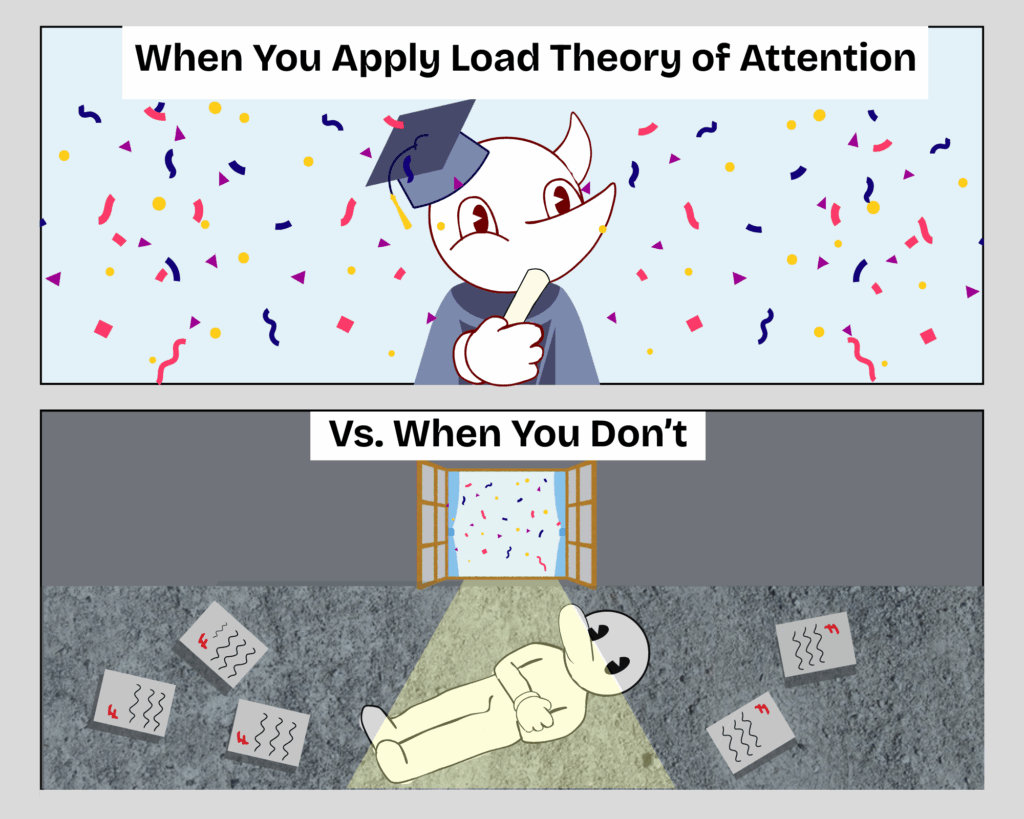
Have you ever noticed that, when you are working on a tough homework assignment, the world shuts down around you? You become hyper-focused on the task in front of you that you barely register someone coughing a few feet away from you or the sound of music playing through your headphones. However, when you pull out your phone and start watching Tik Tok, suddenly every single noise is audible. The person talking loudly across the room, the sound of someone getting out of a chair, the person coughing from early, all of it begins to distract you from your daily doom scroll. Why is that? Well, you may be experiencing something called load theory of attention, and when it comes time to study for those college exams, it may be something you want to be aware of.
Music is an innately human practice. From the humming the song that is stuck in your head to walk out songs to specific life and cultural moments, such as the quinceanera or weddings, music can serve a variety of purposes. In a recent study, researchers found that over fifty percent of college students’ study and do other classwork while listening to music1. This largely due to music through platforms like Spotify making music much more accessible. Music is a powerful form of self-expression, but can music help you be better at school?
“Survival of the fittest” is that old saying that goes on to describe that whoever comes out on top is guaranteed to survive and thrive. Adaptation is what we have to do to ensure the best outcome for survival, and it is not always a physical obstacle. Sometimes our memory is the reason we are able to come up with the survival strategies to adapt to our surroundings. This is called the survival and adaptive value, also known as survival processing and adaptive memory. So, what is survival processing and adaptive memory? Why does this pertain to our everyday lives, and why is it so valuable? Well, we all like to survive and live on to the next day. And, we all adapt to new obstacles everyday, but how much of that would you believe stems from our memory? So is it really “survival of the fittest” or survival of the best memory?
Retaining information from lectures can be a tiring task, especially when you have multiple long lectures back-to-back. Trying to find meaning to the words presented to you via a power point can be more difficult some days than others, especially if your professor is going through the slides too fast. Finding the meaning of the information you are given and how to achieve a better understanding while you are studying for big exams is everyone’s goal in the classroom. But how exactly should one go about it? Well sometimes you need to “think outside of the box” to really connect to the information you are trying to learn. This could also be known as divergent thinking.
What is Divergent Thinking?
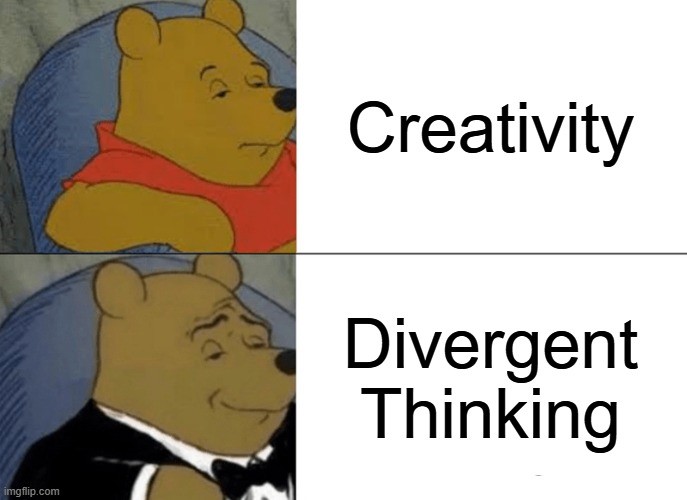
The term divergent thinking was coined by J.P. Guilford during the 1950s. Guilford used the term divergent thinking to describe the processes of deconstructing a topic into parts and then creating as many varied productions as possible within a short period of time 1. Divergent thinking allows one to have a variety of perspectives and allows one to have multiple pathways to answering a problem 2. Divergent thinking is also known to be one of the many ingredients of creativity 3.
ID used to identify users for 24 hours after last activity
24 hours
_gat
Used to monitor number of Google Analytics server requests when using Google Tag Manager
1 minute
__utmx
Used to determine whether a user is included in an A / B or Multivariate test.
18 months
_ga
ID used to identify users
2 years
_gali
Used by Google Analytics to determine which links on a page are being clicked
30 seconds
__utmb
Used to distinguish new sessions and visits. This cookie is set when the GA.js javascript library is loaded and there is no existing __utmb cookie. The cookie is updated every time data is sent to the Google Analytics server.
30 minutes after last activity
__utmc
Used only with old Urchin versions of Google Analytics and not with GA.js. Was used to distinguish between new sessions and visits at the end of a session.
End of session (browser)
__utmz
Contains information about the traffic source or campaign that directed user to the website. The cookie is set when the GA.js javascript is loaded and updated when data is sent to the Google Anaytics server
6 months after last activity
__utmv
Contains custom information set by the web developer via the _setCustomVar method in Google Analytics. This cookie is updated every time new data is sent to the Google Analytics server.
2 years after last activity
_gac_
Contains information related to marketing campaigns of the user. These are shared with Google AdWords / Google Ads when the Google Ads and Google Analytics accounts are linked together.
90 days
__utma
ID used to identify users and sessions
2 years after last activity
__utmt
Used to monitor number of Google Analytics server requests