
By: Braylon Boyer
If I could go back to my first year of college, I wouldn’t tell myself to study more, I would tell myself to study differently. Like most students I thought college was cramming everything to the night before exams and reread notes a million times. It felt productive, but the results didn’t always match my effort.
A concept that changes how we think about studying from cognitive psychology is Levels of Processing. Once you understand it, you stop wasting time on useless strategies and start using ones that work.
What Are “Levels of Processing”?
Developed by Craik and Lockhart (1972), the levels of processing theory suggests that how well you remember something depends on how deeply you process it. Not all ways of studying are equal, some just scratch the surface and some allow deep processing which leads to long-term learning. The Levels of Processing Theory argues that deeper, stronger processing leads to longer lasting memories.
What Are Some Common Processes?
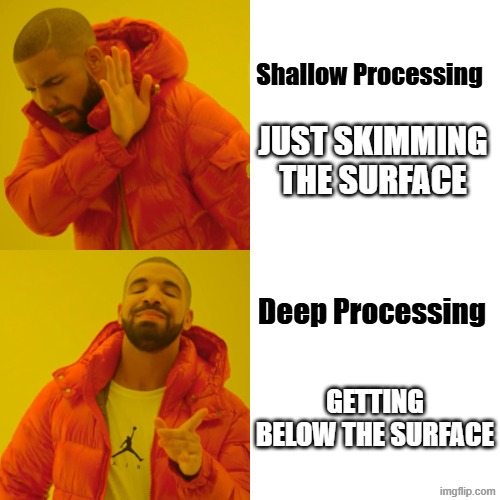
- Shallow Processing
- Just skimming the surface
- Examples (Rereading Notes, Highlighting, Watching Lectures Passively)
- Just skimming the surface
- Deep Processing
- Diving below the surface to find deeper meaning
- Examples (Testing your self, Finding Real-Life Situations, Explaining Ideas in Your Own Words)
- Diving below the surface to find deeper meaning
What Have Studies Taught Us?
One of the biggest things found in cognitive psychology is that depth is better than repetition. In a study by Craik and Tulving (1975), they showed that people remembered words better when they focused on its meaning rather than focusing on the surface features of the word. This says that it’s not just about seeing something over and over but actually engaging with it so it sticks to our memory.
Effortful thinking leads to stronger learning is something I learned that was very important from the research I studied. A technique called self-explanation (Chi et al., 1994) shows that when students actively explain concepts to themselves, they develop a deeper understanding. This happens because the brain is forced to organize, interpret, and connect ideas, rather than simply recognizing them.
Studies on retrieval practice also reinforce this idea. In a study from Roediger and Karpicke (2006), they found that students who regularly tested themselves with their material had significantly better memories than those who just reread the material. The difficulty of testing yourself with the material is actually very important because it leads to deeper learning and strengthens memories.
Finally, a review that shows clear, evidence based research on what actually works. Dunlosky et al. (2013) ranked certain study strategies based on effectiveness. This research showed consistent deep processing techniques towards the top and more shallow, passive strategies ranked much lower.
To Wrap It All Up
At the end of the day, learning is not just about putting in a lot of time, but putting in the most amount of effort you possibly can. Using these strategies will help strenghten your memories (and hopefully give yourself a better grade on the finals that we are all not looking forward to). Even though these changes are small, they can make a massive difference on how you learn.
References
Craik, F. I. M., & Lockhart, R. S. (1972). Levels of processing: A framework for memory research.
Craik, F. I. M., & Tulving, E. (1975). Depth of processing and retention of words in episodic memory.
Dunlosky, J., Rawson, K. A., Marsh, E. J., Nathan, M. J., & Willingham, D. T. (2013). Improving students’ learning with effective learning techniques.
Chi, M. T. H., de Leeuw, N., Chiu, M. H., & LaVancher, C. (1994). Eliciting self-explanations improves understanding.
Roediger, H. L., & Karpicke, J. D. (2006). Test-enhanced learning: Taking memory tests improves long-term retention.
Braylon, I really enjoyed this blog post and it really reminded me of mine when you mentioned creating deeper meaning with the material not just memorizing it. What are some ways you could encourage or examples you could give to people to better learn their material using this idea? I know I reteach myself by going to a whiteboard and pretending i’m in a classroom trying to explain college level material to elementary level students. That is one example I offer, do you have any?
Hello Braylon! I really liked your blog post, this form of studying is new to me. I noticed you had mentioned an article by Dunlosky. What are some of the techniques that were ranked and would you use those techniques to study?